LPPL Insurance Situations

Recently, our Health Minister launched four short social media clips to educate the public about health insurance, in particular riders for IP policies. The take-home message is that riders are expensive and get more expensive as the policyholder gets older. It may be better, especially for an older policyholder, not to buy riders or to buy cheaper riders. Of course, cheaper riders mean less coverage and more deductibles and co-payment. All very sensible. I urge you to watch the clips.

At about the same time, Singapore’s “Blogfather”, aka “MrBrown” aka “Kim Huat” also posted two clips to explain what some colloquial short forms mean. In the second of 2 posts so far, he explained what “LPPL” stands for1.

According to him, LPPL stands for “Laugh Please, Please Laugh”. It can also stand for Log-Periodic Power Law in the field of economics and finance.

To this hobbit, it can also mean a certain location in the human body, namely “Longitudinal Perineum Permanent Location”.

For example, the government introduced the Cancer Drug List (CDL) in 2022. This was introduced ostensibly to empower the government to negotiate for better prices from drug companies and to discourage the use of certain cancer drugs for non-mainstream indications so as to curb rising costs of cancer treatment.

However, many IP insurers then quickly introduced riders to cover for the use of non-CDL drugs. Of course, such riders2, while generating more work and income for some medical oncologists in the private sector, has the downstream effect of encouraging what the introduction of the CDL was meant precisely to discourage  – more use of such drugs which will lead to an unnecessary and avoidable rise in prices and overall healthcare consumption and expenditure

The quick introduction of non-CDL riders by IP insurers effectively negates the policy intent of CDL. And we are back to square one and the government is caught in an LPPL situation. The only consolation is that such riders must be paid with cash.

Why does this happen and why do we allow it? This hobbit doesn’t have the answer. Or even if he thought he knew, he won’t say it here, that’s for sure.

The first thing to know is that we often (if not always) buy insurance because we want peace of mind. Peace of mind is a wonderful thing. But really, if you think about it, the flip side of peace of mind is fear. Fear and peace of mind are but two sides of the same coin. We buy riders for peace of mind, and we buy riders out of fear. The fear that in case we need these non-CDL drugs, we have no access to them and even if we had access, we can’t pay for them. So we buy these riders.

The IP insurers are making lots of money selling these LPPL non-CDL riders in return for giving us peace of mind, or feeding on our fear (depending on one’s perspective).

And as any psychologist will tell you, fear is a great driving force for animals with some intelligence (and that includes humans). The response to fear is a primal one, hard-wired into the human condition through hundreds of thousands of years of evolution, or adaptation, call it what you may.

While this hobbit really likes the Health Minister’s video clips on riders and that he is a great communicator, this hobbit is not sure the clips can countervail the power of fear and the natural response to fear. Especially when this fear and the response to it is also being actively cultivated and reinforced by many insurance companies and insurance agents who get to make a buck or two out of selling such LPPL riders.

Let us move on to another insurance-related matter that has garnered many eyeballs recently. While this matter is about a motor insurance claim, it is nonetheless medically-related.

It was reported that the Courts awarded $417,000 in damages in a traffic accident case. Unfortunately, this decision was arrived at some 5 years after the accident occurred, and only after the traffic accident victim had passed away. The son of the victim, who is his main caregiver for the many years the victim was incapacitated until his death, was the plaintiff.

The sheer callous temerity of the insurance company was most telling. In the opening paragraph of the Judgment3 given by the District Judge, it was stated, “This is a judgment that documents NTUC Income’s wholly unreasonably behaviour”. This hobbit has read quite a few Judgments before, but none has come close to such a resolutely damning statement right at the start of a Judgment document.

In summary, the case involved a person who was seriously injured by a traffic accident. This victim then made a claim against the driver that caused the accident.

It was noted by the Judge that NTUC Income effectively took over the defence of the case because it would have to foot the bill should the courts decide in the plaintiff’s favour.

NTUC Income efforts to deny the claim was akin to “the sort of casually impersonal  stonewalling that some would associate with the worst administrative processes” (Judgment, para 3).

Some particularly galling examples of this impersonal stonewalling –

  • Claims for pain and suffering and amenities was denied because the victim was comatose and could not have appreciated any pain and suffering at all, even though the victim was intermittently conscious until his death (Paras 14 and 17, Judgment)
  • Claims for loss of income was denied, even though the victim was working at the time of the accident (Para. 34)
  • Claims for ambulance-related expenses was denied (Para. 36 of Judgment)
  • Claims for milk powder for the patient was denied because it was too expensive as the patient could have used a cheaper brand such as “Ensure”. (Para. 61 of Judgment). This hobbit is not so sure if “Ensure” appreciates such publicity from NTUC Income.

And if you think this unreasonable behaviour was arrived at because NTUC Income received poor legal advice, the judge made it clear that the lawyers were merely conveying their clients’ instructions. The judge added that the lawyers’ “advocacy was candid, well-organised and fully in line with their duties to the court”.

Against the backdrop of the furore that ensued, the CEO of NTUC Insurance (NTUC Income was rebranded as NTUC Insurance recently) issued an internal memo addressed to “colleagues”. This hobbit obtained a screenshot of this memo, in which he explained the company’s position and then signed off with “Cheers”.

This hobbit must say he has no clue what is there to be cheerful about.

I think the incident shows publicly that the local insurance sector is truly now in a new era of American-style climate of “delay, deny, defend”, which many doctors are already familiar with while caring for IP policyholders in the private sector. So far, the private patients in A1 and B1 class have largely been spared of such agony because IP insurers generally do not question or apply friction to claims for care delivered in restructured hospitals. But who knows what will happen in the future? This may occur sooner than we think.

This case also illustrates the inadequacy of scope in what is offered by the financial and insurance industry to adjudicate claims before it reaches the courts in the form of civil suits. Today, if someone is aggrieved by an insurer, he can take up his case with the Financial Industry Disputes Resolution Centre (FIDReC) which is a platform to adjudicate disputes involving financial institutions (which includes insurers).

However, this is a platform that is only open to the insured (i.e. policyholders who make claims) and their beneficiaries as well as to those parties who have a “customer relationship” with the insurers

It also only covers disputes of up to $150,000.

In this case, neither the victim nor the plaintiff (the victim’s son) is the insured. They don’t have a customer relationship with NTUC Income either. Strictly speaking the plaintiff is not even a beneficiary of the policy as well. What is more, the amounts accumulated over a four-year period far exceed $150,000. So he can’t use FIDReC and so, he has no choice but to sue. But not many people have the financial resources to mount a civil suit. And of course, there is a lot to lose if he does not win the suit. The plaintiff’s legal costs may be easily six-figures if the suit is protracted, and in a worst-case scenario, costs may be awarded against him, i.e. he has to pay for the other party’s costs too.

The plaintiff in this case has obviously weighed his chances, examined his financial resources and then decided to pursue the civil suit route.

As for healthcare-related or IP-related matters, the situation is even worse off in at least three ways.

  • FIDReC is not open to service providers that provide a service or goods to the insured. So, hospitals and doctors who experience unreasonable delays and denials of claims cannot use FIDReC.
  • FIDReC also only handles complaints when a claim has been made, and not before. So FIDReC does not handle issues such as pre-authorisation or how doctor panels are constructed, because no claim has been made.
  • FIRDeC also only handles disputes that are clinical in nature on a voluntary basis. When such a dispute occurs, IP insurers can choose NOT to participate, even if the policyholder has lodged a complaint with FIDReC.

To use a partially real-life example. A patient has an anal fistula abscess. The panel doctor seeks pre-authorisation but is denied. Inexplicably, the case manager suggests that he tries to manage the anal fistula abscess “conservatively” (doctors and nurses reading this, please don’t laugh). This advice to treat an abscess conservatively is not made-up. It actually happened.

If you think the insurer’s case manager should and could be held accountable for making medically unsound and unsafe suggestions and recommendations, you are wrong. Insurers and their employees are not regulated at all for making recommendations and decisions that impact on the clinical aspects of healthcare delivery to their policyholders. For all you know, the case manager has a degree in art history and has recommended the use of Chlorox bleach to treat strangulated piles, and he can get away with such an unsafe recommendation with no consequences to himself or the insurer that he works for. Actually, I exaggerate. I know a few art history graduates who know more about healthcare and medicine than many IP insurers’ case managers. Let’s not unjustly belittle art history grads. They are good people doing good work, which is more than what I can say for many case managers.

OK, this is where the real part ends. We go on to the hypothetical part.

Suppose the surgeon and patient agrees to surgically drain the abscess anyway (because as any 2nd year medical student will tell you, abscesses must be drained – just in case any case manager is reading this and is confused). However, for reasons beyond anyone’s control, the 70 year-old patient with well-controlled diabetes gets pneumonia post-op and gets hospitalised for longer than expected, and the hospitalisation includes 2 days in the ICU.

The claim for the hospital stay is denied because the doctor and patient did not first try “conservative” treatment. The patient/policyholder then files a complaint before FIDReC. The insurer declines to take part in the FIDReC process citing that this is a clinical matter.

What is the patient, surgeon or hospital now to do? The total bill could be say, about $30,000. The aggrieved parties may think that well, the legal fees for bringing this to court alone could well be close to or exceeding $30,000. The surgeon may be fearful that should he pursue the civil suit route, the insurer may well remove him from the insurance panel after this. After all, no reasons need to be given for selecting or removing a doctor from the panel.

And so, all the other stakeholders are again stuck in a LPPL situation, with the insurer being the only party to benefit from such LPPL situations.

Whether we want to admit it or not, “Delay, Deny, Defend” works most of the time. Such is life. LPPL.

1 https://www.youtube.com/shorts/RCSvZUgOCgM

2 https://www.singsaver.com.sg/blog/best-ip-riders-and-supplementary-coverage-for-cancer-protection

3 https://www.elitigation.sg/gd/s/2025_SGDC_150

Grape Cistern Insurance Company: Operation Great Pincer

(For the avoidance of doubt, it is hereby stated that this post is a satire)

Board Memo

To the Chairman and Members of the Board of Directors

Operation Great Pincer (OGP)

I wish to update you that we have begun a major strategic initiative against a hospital service provider – Most Excellent Hospital or MEH in short. This hospital has been a great source of frustration and annoyance to our Company.

This initiative is called Operation Great Pincer (OGP) and its aim is to bring this hospital service provider to its knees and to yield to our Company.

Background

We have to first understand that a hospital needs three other parties to survive: patients, attending doctors and payors. In times past, the payor is often the patient. But nowadays, with bills getting larger, bills are often settled by insurance products which the patients or their employees buy from companies such as us.

Usually, the patient doesn’t really choose the hospital but instead chooses the doctor he wants to consult with, and the doctor happens to work in this hospital or chooses to admit the patient to a hospital where he has admission or attending rights. The doctor is NOT an employee of the hospital but an “attending physician’. In other words, the patient has a choice, and the doctor also has a choice.

Finally, when services have been rendered, the bill will be settled by the payor, I.e., insurance company that sold the insurance policy to the patient/policyholder some time ago.

Once you understand this, you can now proceed to develop a pincer strategy that squeezes the life out of MEH by getting the two other parties to be aligned with the Company: the doctors and the policyholders.

The Pincer Attack

Similar to what we know of a crab claw or crab pincer, a pincer attack must have two limbs or two prongs. Here, as you may have already guessed, one limb or prong is the doctor and the other prong is the policyholder.

A pincer attack or pincer offensive is nothing new. It has been used since the beginning of human warfare and if well executed, is highly effective and deadly. The difficulty lies in getting the two limbs to pivot and close around your prey or enemy until it is encircled and crushed.

A most famous example is the Stalingrad Campaign in World War Two when the Soviet Army managed to mount a counteroffensive by using the pincer attack to squeeze and finally encircle the German 6th Army in Stalingrad in the winter of 1942. By the time the Campaign ended, it was estimated that the Axis forces (led by Germany) lost between 600,000 to 1.1M men (killed, injured, missing or captured). It never recovered from this and it has been said that this was the pivotal moment when Nazi Germany began its inexorable march to ruin and ultimate defeat.

OGP: Our Two-pronged Pincer Attack

Let us now return to OGP and the MEH.

The Build-up

We will first manipulate one of the two prongs to be on our side. And of course, we will choose the weaker prong – the doctors who admit patients to MEH. To this end, I have in my armamentarium the weapon of preferred physician panels. I have already weaponized this by telling these empanelled doctors that they are strongly encouraged to admit to other hospitals and not MEH. To sweeten the deal, I put in place small incentives such as free parking and fruits baskets for my policyholders. Finally I carry the big stick called “depanelment”, which means removal of the doctor from the preferred physician panel. Actually, there is no such word called “depanelment” in the English language. It was probably invented by some insurance executive of antiquity who did not achieve a good grade in English when he was in school; but you get the idea. In any case, I have started the fear rolling like a ball last year by depanelling many doctors.

Launching Operation Great Pincer With The First Prong

In order to maintain the element of fear and uncertainty among panel doctors and to ensure they remain subservient to the Company like groveling dogs, the criteria of depanelment will remain quite opaque and the depanelment process is subject to our whim and fancy. To this end, I have formed a nice sounding department called Provider Management Department and I have instructed it to issue a statement explaining a few of the many reasons for which a doctor can be depanelled. These reasons are ultimately meaningless because it is followed by the one and only factor that really matters, something akin to a Ring to control all other rings (sounds familiar?). This all-powerful clause states “ the Company may or will exercise its sole discretion to make any decision regarding depanelment reasons”. In other words, all the reasonable sounding factors the Provider Management folks have mentioned earlier on in the aforesaid statement are just smoke and mirrors. What really matters is that the doctor’s continued existence on our panel is decided by the Company only. With this, I expect the panel doctor, to toe the line and NOT admit to MEH. But if the doctor still does admit to MEH, then it is time to say “Adios” to him on the panel. It’s not personal, it’s just business.

The Second Prong

Getting doctors to cooperate is the easy part, because doctors are weak. Getting the other party, the policyholders, to work as the second limb of the pincer is more difficult. This is because unlike the doctors who don’t pay our Company, we need policyholders because their insurance premiums keep this Company going. Pincer attacks must be executed quickly and in a coordinated way if you are to trap the enemy and prevent it from escaping. So just one day after our minions have issued the above statement to our panel doctors, the Company will issue another statement saying that we no longer issue pre-authorisation certificates (PACs) to MEH. And without PACs, the issuance of Letters of Guarantee (LOG) will either be very delayed or even not happen at all.

This again has the effect of sowing fear and uncertainty in the second target group, the policyholders, just as we had sowed fear and uncertainty in the first target group, the empanelled doctors.

Without pre-authorisation, policyholders will in all likelihood not get their LOG in time or at all. This leads to two possible consequences for the policyholder:

  1. The policyholder has to stump up cash for his hospital deposit, and also make progress payments along the way during his admission as his deposit is used up to pay mounting bills; and
  2. After the hospitalisation or treatment episode, there is an increased risk that the insurer will not pay his claims since there wasn’t any PAC or LOG issued beforehand.

The first consequence is a matter of cashflow for the insured since his policy is now run on a reimbursement basis. I submit that the hospital can help to alleviate the cashflow burden of the policyholder by waiving the requirement for a deposit or progress payments.

The second consequence is more serious as it is a matter of risk. Without a PAC and LOG, there is an increased uncertainty that the insurer can and will deny the claim. This is something that the hospital cannot address on its own.

To make it sound even more nebulous and scary, our minions will issue statements that obviously run contrary to experience and common sense, like “there is no change to your coverage or benefits when you submit claims or receive treatment with this initiative”. Obviously, cashflow of the policyholder is affected when one has to stump up cash for a deposit when one did not have to do so previously with a PAC. Also, the probability of having a claim denied is obviously higher without a PAC and LOG than when a policyholder has these documents. It has to be so, because if not, then why did we even come up with stuff like PAC and LOG in the first place?

Consequently, all these superficially balmy statements do little to assuage the fear and uncertainty that the policyholder feels when they are told PACs will no longer be issued for certain hospital(s). The trick is that we choose our words carefully, because cashflow and probability of claim denial is not a contractual term or feature of “coverage” or “benefit”. Therefore, while coverage and benefits remain constant in a legal sense, fear and uncertainty in the policyholder increases when a PAC and LOG is not issued.

Encirclement

With this, our second prong, the policyholders, will likewise fall in line with us. Like our panel doctors, they too will also not choose MEH.

With both prongs in place and aligned with us, the Operation Great Pincer (OGP) attack is well underway, and the enemy is choked off from the business that we have previously brought to them. We have entered the final and decisive phase of a pincer attack – encirclement and probable decimation.

The art of the pincer attack is not really the actual decimation of the hospital. But rather, the threat of decimation is sometimes more frightening that the actual act itself. One insurance company cannot decimate a hospital. But many can. As such, the real and great fear of the hospital is that our competitors may do likewise to them.

And so, in time and out of fear, the hospital will yield to us and give us the prices and discounts that we want. We will no longer be price-takers from MEH but instead we will be price-setters. We will then replicate the same strategy with other private hospital operators and be able to cut our payouts to these hospitals drastically, just as we have done so with the doctors using preferred physician panels and fee schedules.

Significant Threats to OGP

At this juncture, it is my responsibility to also point out and evaluate the downside risks of Operation Great Pincer. There are at least two significant threats to OGP that we have to be cognisant of: (1) our competitors and (2) our regulators

Our competitors may steal a little of our market share as new customers who want to buy a health insurance may not choose us, since OGP does limit their choice of hospitals and our repeated depanelment exercises have left our preferred physician panels smaller than before.

But this is a considered downside that we are prepared to stomach. This is because

  1. We are already an insurance company with sufficient heft, with a large pool of policyholders
  2. The market penetration of this sector is already high with a large majority of the potential policyholder pool having already bought health insurance either from us or from our competitors. Future growth is therefore limited
  3. Most of our policyholders will stay with us anyway, since some brilliant minds have already decided that there won’t be full portability in our line of business.
  4. Which means the only real options many of our policyholders have are either to stay with us or stop buying any kind of private health insurance altogether. Those that leave us may not be such a bad thing because they are likely to be older policyholders who are more likely to make claims. This is business we can afford to lose.
  5. Having a slight smaller market share but significantly higher profit margins and actual profits can be a desirable thing.

We have little to fear from our regulators as well. Our primary and first regulator empowered by the relevant legislation, the National Agency for Snooze (NAS) continues to be in a somnolent state. Our other regulator is awake but in truth has few legislation tools under its belt to be of concern to us. We will continue to help them in all earnestness to understand us better. Our strategy is to foment better understanding with our second regulator while avoiding regulation from the first.

Conclusion

Our overarching strategy to increase shareholder value continues to be based on the time-honoured precepts of our industry, which is to Delay, Deny, and Defend. With fear and uncertainty as our allies, we will continue to employ tactics of delay and denial (or threats thereof) against healthcare providers and policyholders, while keeping our regulators far, far away. As long as NAS continues to slumber, there is no need to even defend. Indeed, when one is under-regulated, there is little to defend against.

I remain optimistic about our industry and our company’s future

Finally, if any of you (or your family and close friends who are our policyholders) require medical care from any private specialists and any private hospital, please reach out to me. I will process your requests with the utmost confidentiality and rest assured that your treatment options and insurance coverage are not restricted in any way to any preferred physician panels or preferred hospitals list that the Company may have issued to our policyholders.

Yours sincerely,

Hobbitsma
CEO
Grape Cistern Insurance Company

Andy Lau and the Demographics Behind The Figure of 63%

Recently, clips of a speech by Minister for Manpower, Dr Tan See Leng went viral. It went viral because he quoted from a 2004 Cantonese movie called 江湖 (“Blood Brothers” in English) starring HK heavenly kings Andy Lau and Jacky Cheung, in the recent parliamentary Budget debates. It is a movie about the HK underworld triads and both the heavenly kings were cast as triad bosses. The lines from the movie were used to chastise Non-Constituency Member of Parliament (NCMP) Leong Mun Wai from the Progress Singapore Party (PSP) for repeatedly trying to get data that differentiates between citizens who were born in Singapore and citizens and PRs who were born elsewhere.

Whether you agree with the Minister or not, this hobbit must concede that the incident was quite funny. And it was in Cantonese. This hobbit did not think he would live to see the day when Cantonese would be uttered in Parliament ever since Chinese dialects were banned on national TV in 1979. The first HK TV Cantonese serial that was dubbed into Mandarin in Singapore happened in 1979. The serial was the version of Heaven Sword and Dragon Sabre starring Liza Wang and Adam Cheng (both of them are 78 years’ old now). Yes, this hobbit is that old. I don’t call myself an “old coot” for nothing.

The parliamentary speech segment was so funny that The Straits Times came up with an official English translation the next day. It reads “Even if I’d said it, you wouldn’t listen to it. Even if you’d heard me, you wouldn’t understand. Even if you understood, you wouldn’t do it. Even if you did it, you would do it wrongly. Even if you did wrong, you wouldn’t own up to it. Even if you owned up, you wouldn’t correct yourself. Even if you corrected yourself, you did so begrudgingly. Then what am I supposed to do?”.

This is seminal because for once, parliamentary debate is funny. It hasn’t been so for a long time. Let’s face it, our political leaders just aren’t that funny. And we could all do with more laughs once in a while. Humour is in itself an effective communication tool.

But jokes aside, the important fact that was revealed by the Manpower Minister before he quoted Andy Lau was that 63% of newly created PMET (Professional, Managerial, Executive or Technical) jobs went to local-born citizens.

The PSP NCMPs (Mr Leong and Ms Hazel Poa) then replied over the next two days that there were right to insist on demanding on the breakdown between “old” citizens and PRs (born in Singapore) and “new” citizens and PRs (not born in Singapore) because all the new jobs created could have gone to new citizens and PRs and so there was no benefit to old citizens and PRs. Ms Poa gave a table of figures to illustrate this possibility. This hobbit is told Ms Poa studied Mathematics at Cambridge University and the table is of course 200% correct. (it’s 200% because this hobbit didn’t study Maths in any university).

Mr Leong came up with a Cantonese clip of his own to rebut the Minister. I must say the way he spoke Cantonese was really old school and slick. He reminded me of this famous and handsome actor called Cheung Ying (张瑛) who acted in many classic black and white HK movies from the late forties to the sixties. He died in 1984 and in addition to his acting, he was also known for having had five wives in his lifetime.

But we digress.

This hobbit has no wish to take part in partisan politics because politics is nice to read about but terrible to participate in. Especially the partisan kind. So, this hobbit will not comment on whether 63% is too high or low or whether we should really distinguish between old or new citizens and PRs. But this hobbit readily confesses that all his grandparents weren’t born in Singapore. And he also confesses that he grew up watching movies starring Cheung Ying replayed on TV, in particular on Channels 8 and 10 (The then free-to-air Malaysian channel).

However, demography is something that is taught in medical school (at least when I attended medical school) and this hobbit would like to offer a perspective from a demographic angle.

It is well known that the Total Fertility Rate (TFR) of Singapore has fallen to slightly less than 1; 0.97 to be exact. The number of “resident” babies born in 2024 was 30,800 (babies with at least one parent who is a citizen or a PR). The replacement TFR acknowledged worldwide is 2.1, which is when the population replaces itself with no increase or decrease in population size. Let’s round up our latest TFR to 1 and round-down the replacement TFR to 2.

The replacement cohort size for residents would therefore be 30,800 x 2 = ~61,600, give or take a few. Another fact to note is that for the birth cohorts that are now in the workforce, the cohort sizes were bigger, probably ranging from 40,000 (Millennials and early Gen Z) to >60,000 (Gen X and late baby boomers). In recent years, we have maintained or grew Singapore’s resident population size by maintaining the cohort size of about 60,000 or more per birth cohort through immigration – i.e. by converting non-Singapore born PRs to citizens and giving out PRs to foreigners.

Personally speaking, I do not want the resident population to shrink, as we are already seeing the ill-effects of this phenomenon in places such as Japan. And as a selfish old coot, I would like to see more young people working and paying taxes to fund folks like me who are retiring or have retired. I also do not want to increase the resident population too much too quickly, because this in itself may drive inflation higher and create a very crowded living environment.

But if we are to just maintain the resident population (no increase) and with the resident cohort size continuing to shrink in the more recent cohorts to the now all-time low of 30,000 resident births or so, the government of the day will have to top-up the shortfall with more and more “new” citizens and PRs who were not born here. So going forward, the figure of 63% is almost certain to drop further to 60% or even 50%. Since we have a TFR of 1, it is also very likely that the figure of 50% will be reached in the future, provided our number of resident births do NOT decline further. If it drops to 20,000 births a year, and the replacement cohort size remains at ~60,000, then the figure may even hit a shocking 33%. I.e. Singapore-born citizens only take up ~33% of the new PMET jobs created.

It’s simple maths.

This is a mathematical and demographic certainty if we want to maintain (or maybe even grow slightly) the resident population. Barring the most unlikely scenario of our TFR miraculously rebounding back to 2.1, the figure of 63% will only rise (i.e. >65%) if we are happy to see the resident population shrink or if we are happy to attract new citizens and PRs who take on non-PMET jobs or both, assuming that the number of new PMET jobs being created remains the same over time.

All this is beyond the small brain of this hobbit. But from a mathematical and demographic perspective, the figure of 63% will not, in any likelihood, get any higher, so don’t hold your breath for that to happen. It’s got nothing much to do with favouring new citizens and PRs over old ones but more to do with the lack of resident babies to maintain the resident population. It is essentially a demographic problem. The additional underlying considerations could also be about maintaining or growing the absolute size of the economy (i.e. GDP); as well as the relative contribution by residents to our economy vis a vis foreign workers’ contribution (i.e. those holding Employment Passes, S-passes and Work Permits).

But of course, none of this really matters to the man in the street who has lost his job and is looking for another job without success and to the new graduate still jobless six months after graduation. Which is why this hobbit is pretty sure that Andy Lau and Jacky Cheung are having a better time than our Manpower Minister now. Not to mention Cheung Ying, who had five wives.

The Screwtape Letters (Satiric IP Version)

(With apologies to CS Lewis and “The Screwtape Letters”)

My dearest Wormwood,

I bring you great felicitations from the High Command of the Infernal Insurance Conclave. Your sterling efforts in beguiling the masses and policy wonks have caught the eyes of our Dark Lords there. In particular, the pronouncement that IP policies, (in no small part due to your powers of subterfuge and persuasion) will not be fully portable has gained us valuable breathing space and time.

High Command has given me the most pleasant task of informing you that you have been promoted within the Conclave Lower Ranks to Senior Beguiler Class 2. Our whole family is proud of you, and we are at this very present moment celebrating this news with a salubrious portion of a dead (and unsuccessful insurance claim) policyholder’s flesh and a generous pour of a physician’s blood, toil, tears and sweat. As you can see, even in hell, there can be moments of mirth. And greater mirth there will be, when you return from the frontlines battling those damned policyholders and physicians, while keeping the policy wonks on your side. The 3Ps: Policy Wonks, Policyholders and Physicians. Just keep the Policy Wonks on your side, and you will be fine against the piteous Policyholders and the pathetic Physicians.

By IPs remaining non-portable, we stay immune to the forces of competition and the free market once the unsuspecting customer has bought a policy and has developed pre-existing diseases. It is said that healthcare is an example of market failure. Post-sale IP without portability, and hence competition-proof, is proof of this adage. And yet they still fell right into it. Please forgive me if I sound uncharacteristically gleeful.

We must now press our advantage with our potent miasmatic concoction of deceit and duplicity. On one hand, we will continue our sorrowful and specious tale of not being successful or sustainable as a business, which will gain us much unmerited sympathy from all the silly people in high places.

On the other hand, and with some luck, we will continue to have a low claims ratio, while paying ourselves more and more in the form of management expenses and distribution costs (i.e. commissions). Our ostensibly pitiful tale will be bolstered by the fog of “change in reserves and other expenses”, which will vary a lot from year to year and which nobody can explain clearly why this is so.

Our self-gratifying efforts in terms of ever-increasing management expenses and distribution costs can only be thwarted internally – when those morons on the investment side fail miserably to deliver any returns on their investment activities, and even, Our Father Below forbid, make losses.

But this is only half of the equation. It is imperative that you continue to bring legions of souls to feed the all-consuming IP behemoth that in turns funds our lavish lives. We do this by exposing our multitudinous targets to the coalface of their insecurities and fears, knowing fully well that in the end, half of them who have bought IPs will never make a claim, even when they fall sick in the hospitals. They still opt for the subsidised care funded by public monies, which in turn are mined off the bent backs of our burnt-out taxpayers.

This beauteous state of affairs can only be sustained by ensuring that their fear of not having access to subsidised care after discharge from private care remains palpably intimidating if not paralyzing.

Nearly 70% of the population have bought IPs. Can we do better? 80%? 90%? Delirious joy awaits us if we can hit these higher numbers, which will lead to more and more remuneration and commissions for ourselves.

However, it is my duty to remind you, my dear nephew, that you must never confuse the Policyholder with the Patient. For indeed, while they are physically the same being, the two cannot be more different. The IP Policyholder is a prey that has been captured; a resource that can feed our ravenous appetites for material gratification as long as he pays his insurance premiums every year, while the Patient is someone who has fallen ill and will do exactly the opposite as the Policyholder. The Patient will consume the very same monies that we have so successfully leeched out of the Policyholder. We compete for policyholders. We do NOT compete for patients. Policyholders are good news until they become patients, because patients are bad news. We have great affection for the would-be or pre-policyholder, but we have no mercy for the patient. That is why the Dark Lords of the High Command of the Conclave always publicly say “Our first responsibility is to the Policyholder”. Nobody talks about Responsibility to the Patient.

We must stay the course of limiting access to those pesky physicians. Once again, I recall with great pride and fondness my classmate in the Abyss Academy, Slubgob’s role (now Lord Slubgob) in introducing the idea of preferred physician panels. What genius! This was a turning point in our battle with the Forces of Light. The only thing “preferred” about these panels is that we prefer them to be as small as possible. Indeed, the policy wonks did put pressure on us to increase the size of these panels slightly initially after they were introduced and we did so to superficially appease them. But as long as these panels remain, we have all the aces in the game of limiting access. We also continue to increase the friction in gaining access to these panels for physicians, and obscure our true intent by remaining completely opaque on the criteria that we use to bestow (with that obligatory whiff of sovereign disdain) on a physician a place on our panels. (If truth be known, sometimes we just flip a coin and let the Fates decide). Do remember, that you must make sure a physician knows it in his bones that he exists on our panels at our whim and fancy. If need be, sometimes he must be made to grovel to keep his status as a panel doctor. Like patients, show no mercy to them either. For panel physicians who show no less than perfect obeisance, drop them.

The true power of panels is that they scythe through that most hated and oft-quoted construct called the patient-doctor relationship. The Conclave doesn’t say so publicly, but it finds the concept of the patient-doctor relationship abhorrent and gnaws at the core of what the Conclave stands for, which is lucre.

With panels, we can dismantle old patient-doctor relationships and replace them with transactional claims and disbursements between policyholders and physicians that are completely controlled by us. With panels, we, the intercalators, have surreptitiously become more powerful than whatever detestable direct bond that physicians thought they had with their patients. With panels, we march on with our plans to obstruct and obfuscate.

Finally, we have to stay alert to the powers of the regulators. Fortuitously, they remain somnolent and oblivious to the cries for regulation with regard to the clinical aspects of IPs. We must keep up with our veneer of commitment to participating in whatever mediation or remedial processes the policy wonks have come up with, as long as our participation remains discretionary.

We must once again use our powers of deception and misdirection to keep the current state of non-regulation under the shroud of pseudo-adjudicatory forums. For once we are compelled to participate and follow decisions made by external parties on matters concerning what is appropriate clinical care that should and must be funded by us, we are then regulated, and in truth, quite done for. However, it would be remiss of me not to remind you that we must also keep up the illusion of sincerity and guise of congeniality by participating in some cases which we are most likely to win the debate, while refusing to take part in those many cases where the facts are patently against us.

Please give me an update next month on your continued training in the field of regulatory capture and your masters dissertation on this same subject. Until then, I remain,

Your affectionate uncle,

Screwtape

Hobbitsma’s note:

For the avoidance of doubt, this is satire. All characters mentioned in this post are fictional.

CS Lewis (1898 to 1963) was an Oxford professor in English Literature. He wrote many books, including The Chronicles of Narnia. The Screwtape Letters is a Christian Apologetics fictional novel written by him and dedicated to JRR Tolkien (his contemporary and good friend from Oxford, who wrote Lord of the Rings) and it is written in a satirical and epistolary style.

“First published in February 1942, the story takes the form of a series of letters from a senior devil, Screwtape to his nephew, Wormwood, a junior tempter. The uncle’s mentorship pertains to the nephew’s responsibility in securing the damnation of a British man known only as “the Patient”.

By 1999, the novel had 26 English and 15 German editions, with around half a million copies sold.” (https://en.wikipedia.org/wiki/Screwtape)

Letters to Hobbit 2024

This month, we continue with the tradition of publishing some completely nonsensical letters from our alert but fictitious readers. For the avoidance of doubt, this column is written in the spirit and form of satire. If anyone is offended by this satire, go and suck your thumb. Trust me, it helps. To at least ingest some germs, if nothing else. Your microbiome needs it, since you are so uptight.

<><><><><><><><><><><><><><><><><><><><><><><><><><><><><><><><><><><>

Dear Hobbit

Why do second ward round?

Recently I have been asked by an insurer called Stinklife to justify why I was doing two ward rounds a day for my inpatients. In her email to me, this Assistant Manager of Shield Operations Team (sounds like a person from Marvel Avengers, hence I am very afraid) wrote, “Could you please further elaborate the medical indication/reasons for the justification on why the patient is required 2 visits per day from admission till discharge day. Also kindly state the timing for each visit on each day for our further review”.

I am very perplexed and upset. When I was a young MO working in public hospitals, I was told by my boss that a hardworking and good doctor always tried his best to do two ward rounds a day; a morning round and an evening round. I remember my more conscientious consultants doing their evening rounds with me before they went home.

Now it would appear Stinklife is trying to tell me that my evening round is unnecessary. 24 hours is a long time before an inpatient is seen again, the patient’s condition can turn for the worse in this period.

Dr Chin Du Lan

Cardiologist

Mount Noveau Hospital

Dear Colleague Du Lan,

I am with you all the way here. But it would appear that in our current climate in Middle-earth Healthcare, there is one ring to rule them all – and this is the Ring of the Insurer. This Ring is more powerful than what we learn from textbooks, research papers, CMEs and our professors and role models in the profession. It may have been two ward rounds a day in the past, but since the Wearer of the Ring of the Insurer has spoken, it is now only one round a day. This is mainly because the Wearer of the Ring of the Insurer Regulator sat on his ass for the last 10 years before sailing off into the sunset. The folks holding on to the Ring of the Healthcare Professionals cannot stand up to the wearers of the Ring of Insurers

On a more serious note, I do note that the standard of English from the Shield Operations Team is very bad. Really gave me a ogre-sized headache just going through those two unwieldy sentences.

<><><><><><><><><><><><><><><><><><><><><><><><><><><><><><><><><><>

Dear Halfling

$5.99 Telemedicine

Greetings in the Year of the Smaug. May you HUAT all the way this year, win TOTO 12 million and your Healthier SG patient enrolment hit the roof!

Recently, I received this EDM tilted “Consult for a Medical Certificate”, the EDM further stated “Teleconsult for Minor Illnesses” – Get a medical consultation started in 5 minutes for $5.99 nett”, “No Video Consultation Required” and “SMC Registered Doctors”

Apparently, the medical consultation may just consist of filling up a form. The doctor will review your case (via the form you filled up online) and decide whether to give you an MC or not. They may get in touch with you if they need further information.

Doesn’t this smell of selling MCs? How does one determine a patient is deserving of an MC without a video consultation and apparently by just filling a form?

Can I do likewise?

Dr Chao Geng,

GP, Eat Snake Clinic

Dear Dr Chao Geng

Since you are also a SMC Registered Doctor, you can of course start a service similar to what is mentioned in the EDM. But a word of friendly advice- you should not charge this odd figure of $5.99. You should charge according to how our CDC Vouchers are designed – in multiples of $2, $5 or $10. This would facilitate faster transactions because your payer, I mean patient, doesn’t have to Paynow you the remaining 99 cents. We need to be more payer-centric, I mean, patient-centric.

You should also do a side business of selling snake soup in the shop lot adjacent to yours. I suspect your patients may have a certain predisposition to eating snake-derived products.

<><><><><><><><><><><><><><><><><><><><><><><><><><><><><><><><><><><>

Dear Shorty

Most Trusted Centre

Recently I have been approached by a person claiming to want to give my practice Tulang Orthopaedic Clinic an award for being one of the “Most Trusted Orthopaedic Centres Adopting Evidence Based Practices and Cutting Edge Treatments in 2024”

This award comes with other benefits, including two full-page exclusive story about Tulang Orthopaedic Clinic which will be designed with images, the issuance of a Certificate of Leadership Excellence, two authored articles written by any person representing the practice, among other things.

All of the above will come as long as I paid them USD2500. If I can buy trust and more patients for USD2500, why not? What do you think?

Dr Hoh Seng Lee

Emeritus Senior Consultant Mentor

Tulang Orthopaedic Clinic

Dear Dr Boh Seng Lee, I mean Dr Hoh Seng Lee

I can see why you want to improve your standing and branding in the market. However, you should really ask yourself if anyone reads this publication or website that gives out this award. And how many recipients of this award will there be? Maybe also 2,500?

You may be better off doing a 15 second dance routine on TikTok that highlights the joy of sucking marrow out of a long bone found in a bowl of orc soup. With today’s woke generation, that may get you more patients than getting an award for being “Most Trusted….”.

The Short One

<><><><><><><><><><><><><><><><><><><><><><><><><><><><><><><><><><><>

Dear Adik the Pendek

Who is Responsible?

I performed a haemorrhoidectomy on a 62 year-old in September last year. After sitting on my claim for some 4 months, I received a letter from the insurer last month asking me to give a memo to justify why a pre-operative ECG and Chest X-ray were needed for this patient. To add insult to injury, the email stated, “Please submit a referral letter/doctor’s memo for our review. Kindly note that the doctor’s memo fee (if any) is not payable under the policy”.

The patient is a 62 year-old. Isn’t it routine to do an ECG and Chest X-ray to assess anaesthetic risk? I am wondering who is asking such basic questions? More importantly, if we do not do a proper pre-anaesthesia workout and something bad happens, who is responsible? The insurer or the doctor?

Dr Tan Kah Chng, Giles,

Giles the Piles Clinic

Dear Kah Chng,

I sense much anger in you. That leads to the Dark Side. Anger leads to pain, and pain leads to suffering.

Please see my above reply to Dr Chin Du Lan. Unfortunately, a standard accessory item to the Ring of the Insurer is the Pendant of Non-Accountability. Wearers of this Pendant cannot be held accountable to any clinical outcome, good or bad, even though they can decide how healthcare services are priced, who can perform and get paid for these services. In short, you, the doctor is still responsible if some disciplinary tribunal decides you have not given professional services of a good enough standard by not ordering an ECG or a Chest X-ray for a 62 year-old patient, and then censures or suspends you from practice.

I need to caution you that the person who asked you to justify the investigations may also be a High Priest of the Insurer Order. These High Priests have developed the ability to ask an infinite number of stupid questions that are designed to frustrate and anger you and also to generate more and more paperwork to justify higher and higher management costs for the insurance company they work for.

Yeah, life in Middle-earth sucks for us doctors. Truth be told, if I can be reincarnated, I will want to come back as an Insurer. I am told the wearer of the Ring of Insurance Regulator has been cursed with the Spell of Somnolence by the dark Sauron, the effects of which seem to be permanent. It doesn’t seem the wearer will wake up anytime soon.

Your friendly neighbourhood, Adik the Pendek

Could We Or Covids Have Done Better

The Covid-19 White Paper was released on 8 March 23. This hobbit thinks this was a very commendable effort to look back at what happened that was led by a former Head of Civil Service that is known for his frankness and clarity of thought.

It correctly identified the two major shortcomings made by the government – the U-turn in mask policy and the blow-up in cases that happened in foreign worker dormitories. And this in itself, is a win for transparency and humility. Two very rare commodities in the world nowadays. It is also noteworthy that the two errors arose from essentially the heuristic error of anchoring. Just because the coronavirus in SARS was infectious only when the patient had fever doesn’t mean that another coronavirus will behave likewise. We were anchoring on our past experience with the SARS virus and hoping the Covid-19 virus will behave likewise.

But enough big talk. Now for the small talk that regular readers of this column seem to enjoy much. There are some episodes during the pandemic that are worth remembering but not mentioned in the White paper, just for laughs, if nothing more. These include:

The Virus Vanguard. These are official superheroes no less, since they first appeared in government Facebook webpages, albeit for about only a day in April 2020. We remember our disappeared champions – Circuit Breaker, Care Leh-Dee, Dr Disinfector, Fake News Buster and the (drumroll please) MAWA Man (Must always walk alone, the very antithesis of Liverpool fans). This hobbit hopes that they have NS liabilities, so that in the next pandemic or epidemic we can serve the SAF100 on them to return.

Pivot to F&B Sector. The KTV cluster in 2021 was a result of several KTVs that have “pivoted” to the F&B sector (with assistance and sometimes even grants from the relevant  authorities). A good and well-meaning idea in itself except that these newly pivoted F&B outlets did not have any commercial kitchens. So obviously they had to cook up something else on these premises which resulted in the cluster.

Strangers Sharing Same Hotel Room during Quarantine. At the start of the Omicron wave around December 2021, some folks were made to quarantine in the same hotel room with complete strangers. Naturally, this nutty idea was quickly panned by many. Between a full-height walled cubicle in Singapore Expo and sleeping with a stranger in the same hotel room for about 7 to 10 days, most folks will prefer the former. C’mon, even in an SAF exercise, I have my personal basha tent. This hobbit thinks the guy who came up with this probably liked Frank Sinatra’s “Strangers in the Night” a little too much.

CB and Tightened CB. Kudos to the wordsmiths who were always on top of the word game during the pandemic. These include calling a lockdown a circuit breaker or CB in short. This evolved to a Tightened CB later on. And at about the same time, the government was putting out Chinese-dialect short videos to get the message out to the elderly in the Chinese community. Whoever came up with the tightened CB bit should also be sent for some dialect classes.

Die Another Day. This incident arose also in late 2021 when a MOH Director said mortuary directors could handle dead bodies when the cause of death was Covid-19. This was refuted by the Secretary of the Association of Funeral Directors’ Singapore the next day in The Straits Times Forum which stated clearly that MOH guidelines prohibited them from handling such bodies outside of hospitals. This is clearly NOT a case of Everything Everywhere All At Once as the left hand didn’t know what was happening with the right hand. It is also nice to know the Association was given a President’s Certificate of Commendation for exceptional effort and significant contribution to fighting Covid-19. Incidentally, organisations such as SMA, CFPS, AMS, SNA, SDA and PSS weren’t. Obviously someone either forgot about or doesn’t like these guys?

Let us now get down to the White Paper proper and move back into the serious stuff. What really hit home for this hobbit. The White Paper really had their finger on the pulse when it stated on Page 67:

“However, some of the (i.e. SMM) measures were overly elaborate, difficult to operationalise and explain, and therefore confused the public. Re-opening the economy in phases while limiting the spread of community infections turned out to be a more complicated, and emotionally affecting, journey than expected. All this highlights the need for us to exercise greater flexibility in a crisis, go for broader brush but more implementable measures, and to guard against the instinct to aim for unrealistic standards of perfection”.

On Page 74, the White Paper essentially put out the same message again:

“With future pandemics, we will also need to exercise more flexibility. During COVID-19, at times we allowed the perfect to be the enemy of the good, for example the over-calibration of some SMMs and treatment protocols. In striking the right balance between achieving precision and ease of implementation in our public health protocols, we should guard against leaning too much in the direction of the former”.

Very important points that were most eloquently articulated. Beyond these wise words, this hobbit would like to draw attention to this graphic that was put out in late 2021 by Lianhe Zaobao which told vividly how wrong can matters get:

https://www.zaobao.com.sg/news/singapore/story20211004-1199797

Like what this hobbit has said before, you don’t have to know Chinese to appreciate the ludicrous complexity the “system” had become before thankfully someone decided to implement Protocols 1, 2 and 3.

It is perhaps importantly to go one-step further to discuss why the “system” went off the cliff in terms of complexity and impossibility (rather than ease) of implementation, especially in the area of public health and healthcare.

First, let us remember, whether we like it or not, that protocols, circulars, instructions, directives etc, are written and put in place by people (i.e. real humans, not halflings, elves and orcs). And what drove these people to do what they did? This hobbit can proffer several possibilities:

  • The people who wrote these protocols really have no real on-the-ground experience running healthcare facilities such as hospitals, nursing homes or clinics. They probably grew up in a nice white building; from sitting behind a desk to sitting in a cubicle, before finally being holed up in an office and adorned with a personal assistant to show they have arrived. Hence, just armed with a little theoretical knowledge and no frontline experience, they write protocols the way novelists write fantasy stories.
  • These people are more afraid of losing their jobs more than solving real-life problems, and think that the best way to keep their jobs is to cover their backsides and to write protocols and directives that cover every possibility and exception without thinking how the people on the ground will cope. Never mind you cannot possibly comply with what they wrote. That’s your problem, not these people’s.
  • They are just plain stupid (which is unlikely, since they can write such complicated protocols. Maybe they have spectrum disorder, but they are probably high-functioning ones rather than stupid).
  • Various combinations and permutations arising from the above three possibilities.

There are of course other possibilities, but it would be impossible to explore all of them in the interests of time and readers’ attention. Of course, this hobbit is NOT about to excoriate old wounds, start a new round of fault-finding or try to settle old accounts. But it is important to state that these people have written and issued protocols and directives that have caused untold grief and profound degradation of morale among front-line healthcare workers during the pandemic. This hobbit thinks the morale hasn’t quite recovered fully even now. Quite a few people are still scarred and angry.

So, in the name of all that is good and true, this hobbit beseeches those that are in the high places of power that they do not assign very important tasks such as writing of protocols and directives to these same dangerous people again. Put them somewhere else where they can still earn a living off taxpayers’ money but do less harm, like dress them up as MAWA Man, Care-leh-dee and Dr Disinfector etc and send them to Cosplay conventions. Better still, we can put them onto a Chingay Parade float that has a big overhead banner which has the words “CBs”.

Hobbit Awards 2022

A Happy New Year to the readers of this ridiculously irrelevant column. 2021 has been a year of shattered hope (that we would have gotten the pandemic under control) and realised fears. Delta and Omicron bookended 2021 and the world spent another year in a surreally sad state of ( albeit milder) lockdowns, social distancing and masks.

We now look back at the year that has passed and we dish out various awards to folks who gave colour to 2021, through the eyes of a halfling who is stuffed with beer and suffused with melancholy….

First World to Third Award

Recently, it was reported that close contacts of patients who had contracted the Omicron virus were quarantined in hotel rooms. Many of them were made to share room with complete strangers. Seriously, after spending billions on disease control for the pandemic, we have to save on such stuff? We have to bear in mind this is more than a one-night stand and complete strangers are made to share rooms for several nights. Maybe folks such as Singaporean boys who have done NS and slept in army bunks can accept this, but how about other folks?

Sharing a room with family members and friends is probably OK. But complete strangers?Whoever thought of this needs to get his mind checked (to see if any brain is present in the first place). The foreign press took us to town for this and perhaps justifiably so.

Best Cultural Advancement Award

For centuries, humankind has frowned on nose-digging, especially in public, as a uncouth, distasteful act. Now we have to do it twice weekly in the form of regular ART tests. Now, it is not only public but if you return from VTL flights, it is supervised nose-digging. Trust this hobbit, most people can dig their nose pretty well, with their fingers or with a swab. They don’t need supervision. I actually think these chaps have a strange job – all they do is watch people dig their nose, day-in, day-out…..

No Reality Check Award

This goes to the unknown genius that believed that KTV lounges/clubs etc will willingly pivot to become food establishments without any hanky-panky business. This of course we know became the KTV cluster later on. This is made all the more incredulous when it was discovered that many of these “pivoted” food establishments do not have kitchens to do any serious cooking.

Fat Cats Award

In 2020, Integrated Shield Plan (IP) providers collectively made S103.75M. This hobbit thinks 2021 will likewise be a bumper year for them. Will they pass any of these earnings to the policy holders? Will premiums not rise as such? Will they stop threatening to raise premiums at every call for increasing doctor panel size or improving reimbursement rates for doctors? This hobbit is not holding his breath for this. They are the big winners of this year’s Fat Cats Award.

Stealth Award

This goes to the Life Insurance Association (LIA) of Singapore. For years they have been singing the familiar tune that private healthcare costs are increasing unsustainably because patients are overconsuming and healthcare providers are overservicing and overcharging. This will lead to premiums likewise increasing at an unsustainable rate.

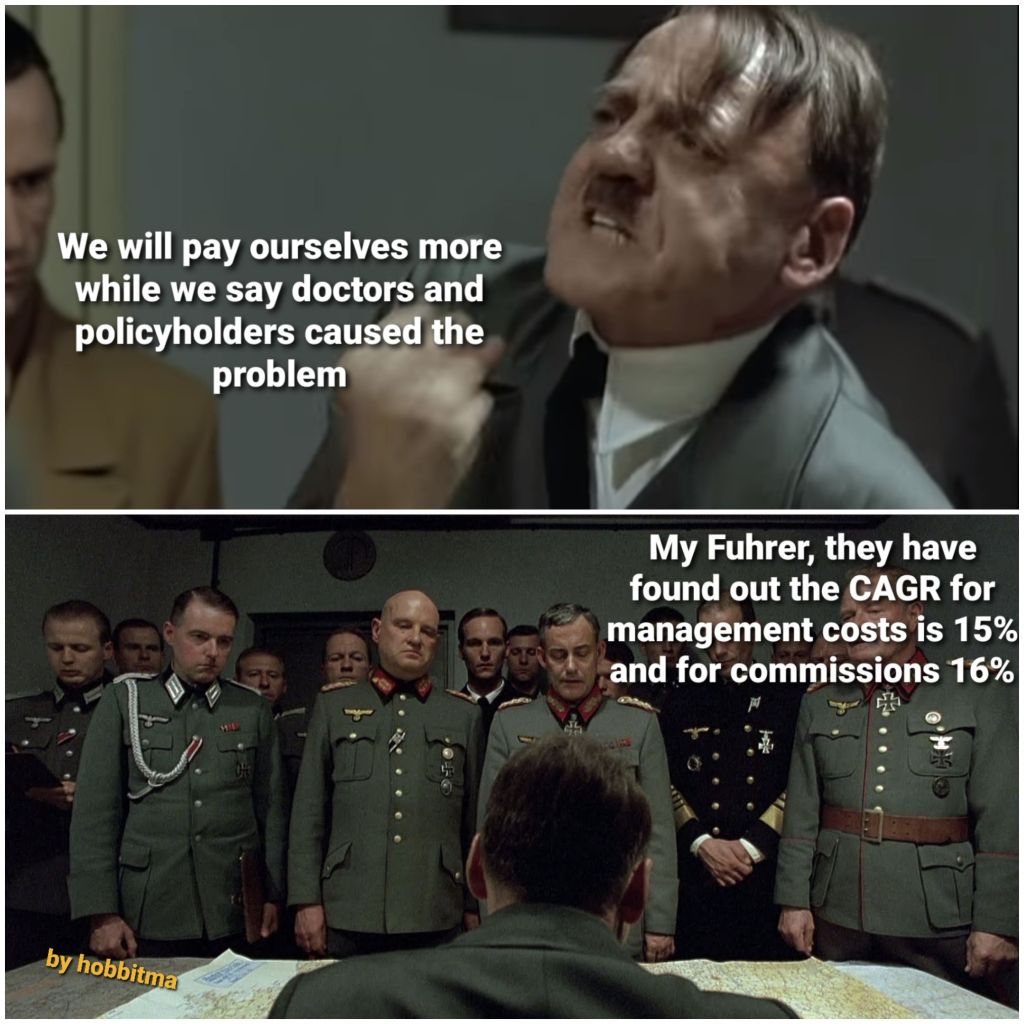
Well, it turns out that for the Integrated Shield Plan (IP) sector, from 2016 TO 2019, Gross Premiums (i.e. total premiums collected) went up by a compounded annual growth rate (CAGR) of 10%; while Gross Claims (money paid out to policyholders who made claims) increased by 11%, while Management Costs went up by 16% and Commissions by 15%!

In other words, the main causes of unsustainability is that the amount of money these IP providers are paying themselves is increasing at a far faster rate than that of premium growth! And all this while, nobody really noticed until recently.

LIA wins the Stealth Award (quietly and invisibly)

Circular King Award

Current DMS wins this award for the second time running. 244 circulars were issued in 2020. 192 circulars were issued in 2021, slightly fewer. But this hobbit thinks that 192 may be an underestimate because a new practice may have emerged. Quite a few circulars were re-issued with updates and amendments and given an alphabet suffix; e.g. Circular 188A/2021 and so on. So the actual number may be around 200 or so.

Not all circulars apply to all doctors. But let’s say we halve that number – to 100 circulars. That would mean that an average of 2 circulars a week require my complete understanding and compliance. That’s pretty scary isn’t it?

Common Sense is Uncommon Award

We allow passengers to take public transport (such as buses MRT trains) with practically no social distancing. But till now, we continue to have alternate urinals and wash basins taped up so that no one can use them.

In some toilets, we even see every other toilet cubicle with full-height partitions likewise adorned with signs that state they cannot be used in order to maintain adequate social distancing.

Do the folks who implement this realise Covid-19 cannot spread through full height partitions, and also one spends considerably less time at a wash basin or a urinal (unless you have serious prostate problems) than in a bus or train ride?

The persistence of such practices reflects what my professor taught me long ago, “common sense is uncommon”.

Complexity Award

Up till early Oct 21, before the introduction of the simplified 3 Protocols, the country’s policies and regulations on Covid-19 quarantine, treatment and recovery were so complex it was really impossible to understand, let alone remember. This was best encapsulated in a flow diagram published in Lianhe Zaobao on 4 Oct 21. You don’t have to understand any Chinese, just look at the diagram. Adjectives such as “bewildering” and “befuddling” are but euphemisms in this instance:

https://www.zaobao.com.sg/news/singapore/story20211004-1199797

Kudos to the folks who contributed to the vast array of policies and regulations that controlled our lives for a few weeks. Even bigger kudos to the Zaobao team for understanding them and compressing all that into one single expansive flow diagram. They are the deserved winners of this year’s Complexity Award.

Road to Endemicity Award

This goes to the Delta variant for breaching our defences at the Jurong Fish Port shortly after the KTV cluster. After these two clusters there was no turning back for us. We were truly well on the road to endemicity…..

Clueless Award

Online commentator Calvin Cheng on 22 May 21 posted, “What are GPs? They are general practitioners who got a degree in medicine, who then either chose not to specialise in a certain field, or were not good enough to be chosen to be specialists. So they became GENERALISTS. They look after small every day illnesses, and once an illness or disease is too complex for them, they refer them to the real experts, a specialist”

Enough said about this guy. He likes to be heard I guess. Even for the worst reasons. He gets this year’s Clueless Award hands down.

Contrast this to what the Prime Minister said at the recent celebrations of CFPS’ 50th Anniversary on 3 Dec 21:-

“As family physicians, you are specialists in your own right. Hospital specialists see patients for a specific condition, but you see patients holistically as a person, across their range of conditions”.

The Facepalm Award

This is a new award category. It is given to the folks who make the most ridiculously embarrassing actions in the previous year. The inaugural award goes to a small bunch of anti-vaxxers who do the silliest things. There was one chap who claimed on social media that he can be contacted via DMS. That was another one who threatened to sue people, including the DMS, the prime minister’s wife and a prominent infectious disease specialist.

By all means, be an anti-vaxxer if you so choose. But don’t do or claim things that make you look stupid or even looney. This is no way to heal any divide….

The Grinch Award

This hobbit thinks Omicron is like the character Grinch in Dr Seuss’s book – How the Grinch stole Christmas. It appeared in November and literally took out the festive spirit in December, just when many people all over the world believed we had the Delta strain under control, and were prepared to travel for holidays and take part in end of year festivities. Maybe we should rename Omicron as the Grinch variant.

Ring Of Inevitability

While it is not enshrined in the Constitution, I consider it my fundamental right as a citizen to be able to sit down in a coffeeshop or hawker centre every morning and have my kopi-O. So when this is taken away from me, I take it that we are in lockdown mode.

Of course this lockdown is not as tough as last year’s CB and Tightened CB. It’s a lot looser this time around. I can still go to my barber, see my dentist and see a show at the cinema. It’s a very ‘loose’ (as opposed to tight or tigher) CB, if it is a CB at all. Unlike what some people say, you can still have a little fun with a very loose CB.

But somehow the wordsmiths have failed us this round by not coming up with something catchy to describe what we are in (like CB and tightened CB). Instead, they have come up with a term like “ Phase 2 – heightened alert”. (Face-palm++).

I take umbrage at the use of the word “heightened”. The use of this word is very insensitive to us short people. As a halfling, I feel I am targeted if not discriminated against whenever I see the word “height” or “heightened” being used. Why can’t people use other terms like “broadened alert” or “widened alert” or just  “light lockdown”? Which is why this hobbit really hopes this country will have a short(er) prime minister soon, who can stand tall, I mean stand-up, for us short fellows.

To avoid the use of this very vexing word “heightened”, I will call the current phase as “loose- lockdown phase” or “LL phase”. “LL” sort of describes rather well how I feel now.

Many friends have asked this hobbit how should we respond to this new LL phase. Well, it’s obvious – just follow law. Stay at home if you can. Cook at home, eat home, work from home etc. Don’t go anywhere unless necessary and if you do, wear your mask and bring your TraceTogether along.

But beyond legal compliance, others have asked – how should we respond intellectually and emotionally?

Some chaps ask rather difficult questions like –

  • Could this LL have been avoided?
  • Could we have closed our borders earlier to countries that were having an exploding number Covid-19 cases?
  • Could we not have this LL phase now?
  • Could we have diversified our foreign labour sources and not take just from one region in the world, just like how we now have four taps to meet our water requirements? Isn’t there just too much risk concentration?
  • Should we have segregated high risk and low risk travellers in Changi Airport like what a Straits Times Forum writer said a month ago prophetically (https://www.straitstimes.com/opinion/forum/letter-of-the-week-stricter-covid-19-measures-needed-for-inbound-passengers-at-airport. (hobbit’s postscript: obviously the writers of the official reply dated 21 April didn’t think so –https://www.straitstimes.com/opinion/forum/airport-takes-multi-layered-risk-based-approach-to-curbing-infection)
  • Should we have better anticipated double mutation strains like B.1.617 are far more infectious than the old Covid-19 strains, considering what was happening in their place of origin?
  • Do we really need to do Routine-Rostered Testing (RRT) for all healthcare workers (HCWs)? Do we not trust our PPE, infection control measures and vaccination to protect our HCWs?

In short, these nasty questions centre around two themes – what lessons can we learn from this setback and are we managing this current wave correctly?

One angsty dwarven banker even asked – between keeping foreign labour coming in to support the construction, process and marine sectors (and helping with economic growth), and now the LL phase – which has a larger effect on the economy and emotional, mental and social well-being of the citizens? What is the trade-off we are talking about? The dwarf remarked – these policy wonks love talking about trade-offs all the time, but somehow nobody is talking about trade-off between keeping the process, marine and construction sectors going and what we are suffering now for four weeks.

I will be honest, having grown up in a fun-loving, carefree, beer guzzling shire in Middle-earth, all these questions are terribly complicated and distressful to me.

But a wise elven wizard helped this hobbit see the light when he commented on this statement:

“These cases all originated from imports because all borders are porous. All it takes is one case to cause an outbreak, and no country can seal itself off totally. At the minimum, citizens and residents must be allowed to return home”. (MOH Facebook Page, 15 May 2021)

He said, “this means it was all inevitable. Just like the Mother of All Clusters (MOAC) in the dorms last year. That was nothing we could have done. MOAC would have happened anyway. Similarly here. It was pre-ordained that we need to have those foreign workers coming in to support the process, construction and marine sectors. Thus we need to take the risk of these imported cases coming in, even though we know that it takes only one case to cause an outbreak”.

He added, “It was also predestined that the super-infectious B.1.617 strains would have led to the Changi Airport and TTSH clusters and probably now the tuition centre/schools clusters as well”.

He concluded, “Everything was preordained and predestined and hence inevitable. We made the right calls, no error of judgment was made. This is the way”. (In an elven accent – not Mandalorian)

Yes, it was all inevitable. And once we accept this explanation, a lot of other questions are also answered or become moot as well. It’s like you are playing an online role-playing quest game, and your avatar discovers this powerful magic item (more like you paid bucket-loads of money for it) that gives your avatar enormous benefits. Example – you discover the Amulet of KNN – which renders your character immune to psychic attacks, -8 to mace attacks, +5 to dexterity score and +50 hit-points.

The elven wizard then introduced me to this magic item called the Ring of Inevitability. He fished it out of the pocket of his Cloak of Non-culpbability; the Ring burnished under the midday light and I was immediately desirous to obtain it.

He whispered to me that once the wearer has the great magic item called the Ring Of Inevitability, he will be immune to questions such as “if only we had….?”, “Could we have…?”, “Could we not have….?” etc., etc. from all those around him, including himself. Such tiresome questions become inconsequential once we wear the Ring of Inevitability.

And he was right. Once I bought the Ring of Inevitability from him and wore it, I was happier and more peaceable immediately. I no longer asked myself all these vexatious questions and could accept the current LL phase with the kind of equanimity that Sir William Osler described. I also dismissed such questions from those around me as irrelevant and even irreverent to me, the mighty Ring-wearer. I felt l have become invisible to obnoxious questions as they passed right through me. I no longer took umbrage to these questions anymore as I became as invisible to these questions as the Nazgul Ringwraiths of the Second Age in Middle-earth.

I didn’t even feel LL at all about this LL phase anymore. Gosh, I hadn’t felt so good since I was given fentanyl by my anaesthetist for a procedure years ago…..

Before he left, the elven wizard grinned and said, “You should consider taking the Cloak of Non-culpability as well. The Cloak makes all accusations against the wearer hollow and ineffectual. It goes extremely well with the Ring of Inevitability”.

Note: for the avoidance of doubt – this post is a satire.