A Serial Nobody

On 19 May 21, World Family Doctor Day was celebrated around the world. Just three days later, ‘social influencer’ Calvin Cheng puts out a Facebook post in response to a statement released by 12 doctors.

The Facebook post stated, “What are GPs?

They are general practitioners who got a degree in medicine, who then either chose not to specialise in a certain field, or were not good enough to be chosen to be specialists. So they became GENERALISTS.

They look after small every day illnesses, and once an illness or disease is too complex for the, they refer them to the real experts, a specialist”.

First, let’s get back to the original statement put up by the 12 doctors. The statement questioned the safety of mRNA vaccines, in particular, for children; and advocated the use of “killed” vaccines instead. The statement was frankly, not based on current evidence and without much merit. In any case, the proper and usual word in this context for “killed” is “inactivated” or “deactivated”.

Next, there are specialists in the list of 12 doctors, including specialist physicians and surgeons, and also GPs.

So plainly, Calvin Cheng got the facts wrong.

By Calvin Cheng’s measure, GPs are GPs either by choice (“chose not to specialise”) or they were not good enough to be chosen to be specialists. They are also not “real experts” and only look after “small, every day illnesses”. In other words, to him, GPs are inferior doctors by choice or by lack of ability.

Well, that would mean the following people are inferior doctors:

  • Our Manpower Minister, Tan See Leng, was a GP for many years. And a very well trained one, with a M.Med (family medicine) and FCFP, the highest academic qualification given by the College of Family Physicians Singapore (CFPS). He went on to run IHH, one of the largest listed companies in Malaysia and Singapore with a market capitalisation well in excess of S$10B.
  • The founder, and Chairman of Raffles Medical, Dr Loo Choon Yong, is a GP. He is a veritable billionaire, owning about half of Raffles Medical. The market capitalisation of Raffles Medical is currently about $2B.

On the other hand, the company Calvin Cheng co-chairs, Retech Technology Co Ltd (listed on ASX, the Australian Stock Exchange) has a market capitalisation of about A$65 to A$70M. The company was listed a few years ago at 50 cents. It is now languishing below 30 cents.

So who is Calvin Cheng?

Here’s what can be found about him from publicly available sources:

  • He is 46
  • He was educated at Oxford University
  • He started his working life by running model agency franchises, and later founded an agency called Looque Models Singapore
  • He was also President of Association of Modelling Industry Professionals Singapore (AMIP)
  • He was a Nominated MP from 2009 to 2011
  • He was appointed a member of the Ministry of Communications and Information’s (MCI) Media Literacy Council (MLC) in 2012. He held this appointment for four years (two 2-year terms). The MLC is supposed to “promote civility and responsibility on the Internet”.

In 2011, the Competition Commission of Singapore (CCS) fined 11 modelling agencies for price-fixing; according to the Wikipedia webpage for Calvin Cheng (https://en.wikipedia.org/wiki/Calvin_Cheng#cite_note-14): –

“On 23 November 2011, several model agencies, including Looque Models, were fined for price fixing. Cheng profited from the higher agency commissions, claiming in defense that the goal was to raise wages for models. The CCS ruled that Association of Modelling Industry Professionals Singapore (AMIP) engaged in anticompetitive price-fixing, resulting in customers paying more and having a considerable and adverse impact on the market. The Competition Commission of Singapore (CCS) noted in its decision that as president of AMIP, Cheng played a central role by instructing AMIP members how to mask the collusion to evade detection and complaints. Cheng appealed, claiming that statements in the decision were damaging to his character; the appeal was dismissed because he had not been personally fined”.

For a more detailed account of this distasteful affair, one can go to:https://redwiretimes.com/former-nmp-calvin-cheng-accused-role-price-fixing-scandal/

And despite this incident in 2011, he was appointed to be a member of a prestigious government committee, the MLC, in 2012. This shows Singapore is indeed a land of second chances. But he didn’t take the appointment well. This can be seen by the fact that he later made some very controversial comments about terrorists’ children while he was a MLC member. https://www.todayonline.com/singapore/calvin-chengs-killing-children-remarks-insensitive-and-inappropriate-mlc-chairman

So as you can see, we really don’t have to take this chap seriously. Even though he was a NMP and a MLC member. This hobbit would like to suggest that deep down he knows that after being a NMP, he has become a serial nobody. So he tries to get attention by passing provocative comments in order to generate attention and responses from the community he attacks. In other words, he is a troll. He is a discredit to the parliamentary institution of NMP. As for his Oxford pedigree, well, Oxford also has a tradition of producing comedians, like Rowan Atkinson and Hugh Grant. Calvin Cheng is still a comedian, albeit a bad one.

Anyway, today, an unusual letter to The Straits Times Forum has been printed. It has no less than five signatories, although only two were featured: MOH and CFPS. The other three signatories mentioned were SMA, Academy of Medicine Singapore and Chapter of Family Physicians. The letter was meant “to address the misinformation in recent social media posts containing inaccurate statements about general practitioners”.

The letter went on to describe how GPs are trained and Family Medicine is recognised as a proper clinical discipline, and how GPs play essential roles in healthcare.

More damningly, the letter ended with this paragraph, “When writing about issues in the public sphere, we expect effort be made to check the facts. In a civil discourse, this is the responsible thing to do”.

Most readers will suspect strongly who this letter is referring to: – the person who was propagating misinformation in an irresponsible way as part of an uncivil discourse. Interestingly, the letter did not mention a person’s name. This hobbit thinks there is a reason for this: the letter is referring to a serial nobody whose name is not even worth mentioning.

Ring Of Inevitability

While it is not enshrined in the Constitution, I consider it my fundamental right as a citizen to be able to sit down in a coffeeshop or hawker centre every morning and have my kopi-O. So when this is taken away from me, I take it that we are in lockdown mode.

Of course this lockdown is not as tough as last year’s CB and Tightened CB. It’s a lot looser this time around. I can still go to my barber, see my dentist and see a show at the cinema. It’s a very ‘loose’ (as opposed to tight or tigher) CB, if it is a CB at all. Unlike what some people say, you can still have a little fun with a very loose CB.

But somehow the wordsmiths have failed us this round by not coming up with something catchy to describe what we are in (like CB and tightened CB). Instead, they have come up with a term like “ Phase 2 – heightened alert”. (Face-palm++).

I take umbrage at the use of the word “heightened”. The use of this word is very insensitive to us short people. As a halfling, I feel I am targeted if not discriminated against whenever I see the word “height” or “heightened” being used. Why can’t people use other terms like “broadened alert” or “widened alert” or just  “light lockdown”? Which is why this hobbit really hopes this country will have a short(er) prime minister soon, who can stand tall, I mean stand-up, for us short fellows.

To avoid the use of this very vexing word “heightened”, I will call the current phase as “loose- lockdown phase” or “LL phase”. “LL” sort of describes rather well how I feel now.

Many friends have asked this hobbit how should we respond to this new LL phase. Well, it’s obvious – just follow law. Stay at home if you can. Cook at home, eat home, work from home etc. Don’t go anywhere unless necessary and if you do, wear your mask and bring your TraceTogether along.

But beyond legal compliance, others have asked – how should we respond intellectually and emotionally?

Some chaps ask rather difficult questions like –

  • Could this LL have been avoided?
  • Could we have closed our borders earlier to countries that were having an exploding number Covid-19 cases?
  • Could we not have this LL phase now?
  • Could we have diversified our foreign labour sources and not take just from one region in the world, just like how we now have four taps to meet our water requirements? Isn’t there just too much risk concentration?
  • Should we have segregated high risk and low risk travellers in Changi Airport like what a Straits Times Forum writer said a month ago prophetically (https://www.straitstimes.com/opinion/forum/letter-of-the-week-stricter-covid-19-measures-needed-for-inbound-passengers-at-airport. (hobbit’s postscript: obviously the writers of the official reply dated 21 April didn’t think so –https://www.straitstimes.com/opinion/forum/airport-takes-multi-layered-risk-based-approach-to-curbing-infection)
  • Should we have better anticipated double mutation strains like B.1.617 are far more infectious than the old Covid-19 strains, considering what was happening in their place of origin?
  • Do we really need to do Routine-Rostered Testing (RRT) for all healthcare workers (HCWs)? Do we not trust our PPE, infection control measures and vaccination to protect our HCWs?

In short, these nasty questions centre around two themes – what lessons can we learn from this setback and are we managing this current wave correctly?

One angsty dwarven banker even asked – between keeping foreign labour coming in to support the construction, process and marine sectors (and helping with economic growth), and now the LL phase – which has a larger effect on the economy and emotional, mental and social well-being of the citizens? What is the trade-off we are talking about? The dwarf remarked – these policy wonks love talking about trade-offs all the time, but somehow nobody is talking about trade-off between keeping the process, marine and construction sectors going and what we are suffering now for four weeks.

I will be honest, having grown up in a fun-loving, carefree, beer guzzling shire in Middle-earth, all these questions are terribly complicated and distressful to me.

But a wise elven wizard helped this hobbit see the light when he commented on this statement:

“These cases all originated from imports because all borders are porous. All it takes is one case to cause an outbreak, and no country can seal itself off totally. At the minimum, citizens and residents must be allowed to return home”. (MOH Facebook Page, 15 May 2021)

He said, “this means it was all inevitable. Just like the Mother of All Clusters (MOAC) in the dorms last year. That was nothing we could have done. MOAC would have happened anyway. Similarly here. It was pre-ordained that we need to have those foreign workers coming in to support the process, construction and marine sectors. Thus we need to take the risk of these imported cases coming in, even though we know that it takes only one case to cause an outbreak”.

He added, “It was also predestined that the super-infectious B.1.617 strains would have led to the Changi Airport and TTSH clusters and probably now the tuition centre/schools clusters as well”.

He concluded, “Everything was preordained and predestined and hence inevitable. We made the right calls, no error of judgment was made. This is the way”. (In an elven accent – not Mandalorian)

Yes, it was all inevitable. And once we accept this explanation, a lot of other questions are also answered or become moot as well. It’s like you are playing an online role-playing quest game, and your avatar discovers this powerful magic item (more like you paid bucket-loads of money for it) that gives your avatar enormous benefits. Example – you discover the Amulet of KNN – which renders your character immune to psychic attacks, -8 to mace attacks, +5 to dexterity score and +50 hit-points.

The elven wizard then introduced me to this magic item called the Ring of Inevitability. He fished it out of the pocket of his Cloak of Non-culpbability; the Ring burnished under the midday light and I was immediately desirous to obtain it.

He whispered to me that once the wearer has the great magic item called the Ring Of Inevitability, he will be immune to questions such as “if only we had….?”, “Could we have…?”, “Could we not have….?” etc., etc. from all those around him, including himself. Such tiresome questions become inconsequential once we wear the Ring of Inevitability.

And he was right. Once I bought the Ring of Inevitability from him and wore it, I was happier and more peaceable immediately. I no longer asked myself all these vexatious questions and could accept the current LL phase with the kind of equanimity that Sir William Osler described. I also dismissed such questions from those around me as irrelevant and even irreverent to me, the mighty Ring-wearer. I felt l have become invisible to obnoxious questions as they passed right through me. I no longer took umbrage to these questions anymore as I became as invisible to these questions as the Nazgul Ringwraiths of the Second Age in Middle-earth.

I didn’t even feel LL at all about this LL phase anymore. Gosh, I hadn’t felt so good since I was given fentanyl by my anaesthetist for a procedure years ago…..

Before he left, the elven wizard grinned and said, “You should consider taking the Cloak of Non-culpability as well. The Cloak makes all accusations against the wearer hollow and ineffectual. It goes extremely well with the Ring of Inevitability”.

Note: for the avoidance of doubt – this post is a satire.

The Hobbit’s Guide To The Highlights Of LIA’s Position Paper and Industry Responses On IPs

After SMA’s Position Statement on Troubled IPs (29 March), the Life Insurance Association (LIA) responded with 2 and a half documents:

  • Industry Response dated 29 March 21
  • (Updated) Response dated 31 March 21 (This hobbit gives discount, count this as half document)
  • Position Statement (1 April 21)

Talk about overkill.

If you have trouble following their chain of thought and writing, this Hobbit will now give you an easy to understand informal guide to the highlights of these documents. Unless stated, the quotes refer to the Position Statement dated 1 April 21. Quotations are given in italics.

Highlight #1: What Has LIA Got To Do With Cost Containment?

Page 1, Last Paragraph lists the various cost containment measures: panels, copays and pre-authorisation, fee benchmarks to nudge positive changes in healthcare providers’ behaviour.

Page 2, Paras 5 to 7 states:

“The question really is, what balance should be struck between various cost containment measures?

The honest answer is that LIA Singapore and individual insurers do have a definitive answer as to what the right balance of measures is”

It will need to be an iterative process, because there will be trade-offs between the interests of policyholders, patients, and healthcare providers that all parties need to accept. Insurers are in the middle trying to seek the best balance to this equation in a sustainable manner”.

Please note that all the containment measures mentioned involve policyholders, patients and healthcare providers. They do NOT involve insurers. Insurers are just “trying to seek the best balance”.

Hello, dude, how about containment measures involving direct action by insurers, such as cost cutting insurers’ commissions and management costs?

In a newspaper article, the LIA spokesman further added, “Insurers agree that we should control our own costs but we don’t really think there’s a lot of fat in our expenses to be cut,”. [1]

Ownself say ownself got little fat, with no substantiation. This is really quite laughable and not worth the paper it is printed on. It’s like an alcoholic saying “I don’t booze too much”.

If every stakeholder also just say categorically, “we don’t really think there’s a lot of fat in our expenses to be cut” then everyone can just suck thumb, drink coffee and nothing will get solved. 

So these guys are still in denial that they are part of the problem. Sorry, but the Singapore Actuarial Society (SAS) has numbers to prove otherwise. Bloggers such as life finance also think insurers are a big root cause of the problem of IP sustainability.

Highlight #2: Possible Anticompetitive Behaviour By A Trade Association

Industry Response (29 March 21) (Page 2, Para 2)

The upper bound of the MOH Fee Benchmark range for a procedure can be up to five times of the lower bound4 . As such, proceeding per SMA’s suggestion without calibration may lead to substantial cost increases and further premium increases for policyholders.

Industry Response (31 March 21) (Updated) (Page 2, Para 2)

The average ratio of upper bound to lower bound for surgeon fee benchmarks is 1.84 . As such, proceeding per SMA’s suggestion without calibration may lead to cost increases and further premium increases for policyholders.

Position Statement (1 April) (Page 3, Last Para)

“Given that the upper bound is, on average, 1.8 times of the lower bound, setting panel fees at the upper bound of the MOH Fee Benchmarks will likely lead to escalation in claims costs and, as a consequence, premiums.”

These are very serious statements to make in the face of countervailing evidence; in particular, with respect to that of the high probability, if not inevitability of premium rises.

The SMA has, in its Position Statement on 28 March, called for all IP insurers to respect the full range of the MOH Fee Benchmarks instead of clustering their reimbursement fee scales around the lower end of these Benchmarks. The SMA further stated that one IP insurer (NTUC Income?) was in fact able to reimburse the full range of the Benchmarks, i.e. as long as panel doctors charge within the range of the Fee Benchmarks they will be paid as such.

It is therefore surprising to see the above quotes from LIA stating that premium rises are very likely?

How did LIA which can be considered a trade association of sorts, come to this conclusion when already a major IP insurer (NTUC Income) can reimburse up to the upper bound of MOH Fee Benchmarks without increasing premiums and in fact apparently generated a profit in 2019?

This statement by LIA therefore essentially tries to exclude or at least diminish the possibility that an IP insurer can respect the full range of benchmarks without raising premiums when an alternative reality already exists.

Therefore, this statement can be construed to either be encouraging IP insurers to set their fee scales to cluster at the lower end of MOH fee benchmarks and not to reimburse using the full range of MOH fee benchmarks or persuading IP insurers to raise their premiums should they respect the entire range of fee benchmarks, even when they may not have to do so in order to achieve profitability. The latter is clearly against consumer and even public interest, especially when about 70% of Singapore residents have bought IPs.

Declaring that increasing premiums as the preferred or most probable solution when other options and alternatives already exist can be considered to be an indirect form of price-fixing by a trade association such as LIA.

Relevant regulatory authorities may want to look in this possibly anti-competitive behaviour by a trade association.

Highlight #3: The Truth is OUT, Panels Are Really About Fee Control, not Quality Control

Page 2 Para 10 states “the underlying concept of a panel is to use the insurer’s bargaining power to negotiate preferential rates from healthcare providers in exchange for higher volumes. This is the way panels work in the employee benefits space in Singapore, and in multiple markets overseas. It is no different from the use of group procurement in industries outside healthcare. So long as a reasonable fee is left on the table for the doctor, and savings are passed on to policyholders in the form of lower premiums, this is a reasonable approach to take. Insurers are playing the role we should in stretching the healthcare dollar for policyholders.”

Bluntly put, as the above quote shows, panels are about fee control. But with IP insurers’ fee scales already clustered around the lower end of the Fee Benchmarks, how much lower do these IP insurers (sans one) want to go? Obviously they intend to bargain Panel Doctors to the bone and go below the benchmarks. If not why have panels when prices are already at the lower end of Fee Benchmarks?

So for those specialists who think short term and want volume now, be warned that you may be squeezed and squeezed on price later on. This reminds this hobbit a little of what Churchill said about appeasers and crocodiles.

The LIA has repeatedly claimed that larger panels will increase prices. Page 2 Para 4 states “Removing panels as a control measure means that insurers would have to seek other ways to compensate. These would likely take the form of increased premiums, increased co-pays, and/or stricter application of pre-authorisation.”

This statement has perplexed many doctors. If the insurers already control the fee scales, why would larger panels necessitate increases in premiums and co-pays?? In such an environment, overcharging is almost impossible and fee scales already cluster at the lower end of the Benchmarks. That leaves overservicing as a possible problem which can be easily solved by audits, hopefully independent audits.

So the real issue here is again, that with larger panels, insurers cannot bargain with doctors to offer their services at ever lower and lower prices. Larger panels do not by themselves contribute to higher premiums, especially if the services offered are clinically indicated and when insurers already control reimbursement rates.

In fact, as one smart observer mischievously commented, “if larger panels entail higher costs and premiums, then no panels will have no costs and lower premiums”.

A more subtle reading of this LIA claim is that perhaps insurers want to shift work back to the Restructured Hospitals (RHs). When panels are large, a policyholder can easily find a specialist. When panels are small, the policyholder may just give up and go back to RHs. There is nothing wrong with this, if MOH wants more work for the RHs.

This is already happening. As of 1 April 21, a major IP insurer revamped its offering to that of claims-made premiums. There are several premium levels a policyholder can pay. If he claims less he pays less. Nothing wrong with that. But it also states that if you seek care at private hospitals and the claims exceed $1000, your premiums (or premium level) go up. But if you go to a RH, your premiums go down one level (unless you are already at the lowest level then your premiums can’t go down anymore), irrespective of how much the claims are.

Again, nothing wrong with that as an incentive to control claims cost by insurers, because this hobbit is neither for or against RHs or private specialists. But good luck to our already very crowded RHs with long waiting times. One must also question if this is in-line with the government’s policy intent of having private hospital IPs in the first place.

Highlight #4: The Smoke Grenade of Enforcement

Page 3 Para 1 states “the fee benchmarks do not include an enforcement mechanism”. LIA goes on to say in the next para, “This issue of enforcement can be addressed through the appointment of panels, within which doctors sign on to enforceable contracts, and are therefore legally bound to charge within the agreed fee range”.

This really takes the cake, folks. Doctors and facilities get paid by an IP insurer AFTER a service has been rendered and resources consumed. What is there to enforce?

All the IP insurer has to do is state up front their fee scales and state they will NOT reimburse above this scale. This is not a situation whereby the doctor already took the IP money and the IP insurer is trying to claw back the money and therefore need some enforcement mechanism.

The IP insurer just pays up to its fee scale and the doctor cannot do anything much. What are the chances the doctor will sue and get more money than what is stated upfront on the fee scale, and more importantly, what are the doctor’s chances of winning such a law suit?

In fact, doctors and facility providers are the parties that really need an “enforcement mechanism” to ensure insurers pay up and pay up promptly, not the other way around!

Highlight #5 : Five Is NOT Equal to ALL Seven

LIA gives us some interesting data in Annex A, which hopefully the regulators can verify, because doctors and policyholders can’t. More Interestingly, it only has five out of seven IP insurers’ data, which means it is an incomplete picture, unlike SAS’s data which is based on all seven insurers.

It shows, as LIA has claimed, that insurers do pay above Fee Benchmarks some times. But obviously panel doctors are paid less than non-panel ones generally.

But the fact remains we do not know who these two omitted insurers are. Until data from these two insurers are out, it is not possible to draw conclusions at the national level, which is the most important thing for a meaningful discussion to take place. After all, these two omitted insurers may be large players with very sizeable market shares and therefore data presented in Annex A may be therefore significantly skewed.

 Highlight #6: Medishield Life’s Claim Rates May Be Excessive

Page 4, Para 6 states

“That IP claim rate trends are similar to Medishield Life’s claim rates trends are not surprising and implies nothing about whether or not the claim rate inflation is excessive”

SMA benchmarked the IP claims rate to that of Medishield Life’s (MSL) because that is the best SMA has at hand. By making this statement, LIA is suggesting that MSL Claim Rate may be excessive, even though MSL has features such as copayment and deductibles in place to address overconsumption.

Since this involves MSL, the government should come out and explain its position and understanding of the situation  – whether the MSL Claims Rate is excessive or not. It can either agree with LIA or refute it. Either way, this should be done and the public will be better informed for it.

Highlight #7: The Second Smoke Grenade of Longer Analysis Periods

Page 4, 3rd Last Para:

“Based on aggregate amounts, cost per claim has not risen in recent years . However, IPs have been around for many years now, and 2016-2019 is a relatively short part of this history. We should therefore take a longer-term view to understand the fuller picture”.

LIA went on to then analyse data from 2010 to 2019 (instead of Singapore Actuarial Society’s 2016 to 2019) and concluded “cost per claim rose very sharply from 2010 to 2014” to justify why recent rises for claims were more moderated (~ 10%). The longer dataset was used to justify that increases in management costs and commissions were actually more moderated over time (Page 6, Figure 2).

When it comes to prices and costs, recentness is everything. Can you imagine trying to recruit a person for an executive opening and saying he is offered the post for a salary of $2500 because that was the salary given for that job in 2010? The candidate will laugh at you.

Or the government saying property inflation isn’t so bad because over the last 10 years, the rise was moderate? Potential property buyers take reference from recent price increases, not what happened in 2010.

In fact, why stop at 2010? Maybe if we extrapolate back to 1965, the Compound Annual Growth Rate (CAGR) for management costs will drop to 1%. Who knows? And if you go back to when Sir Stamford Raffles landed in Singapore, the CAGR will drop to 0.3%.

As the saying goes, no need to talk about the time when policeman wore shorts. For issues such as costs and prices, it is here and now. Or the recent past few years at best. The older the data, the less relevant it is to addressing today’s problem on costs and prices.

Highlight #8: If 10% is bad, 15%/16% is worse!

Page 5, Para 2:

“The key question, which remains unanswered, is whether a 10% CAGR in claim rate is appropriate and manageable. The implications of continued claim rate inflation of this magnitude are potentially serious”.

The hobbit agrees that 10% CAGR may be actually bad.

As a first step to achieving sustainability, all cost components must have a CAGR that is less than the premium CAGR. Claims rate CAGR is now 11%, just 1% more that premium CAGR. We can talk about lowering the premium CAGR to less than 10% when cost components are approximate at the premium CAGR.

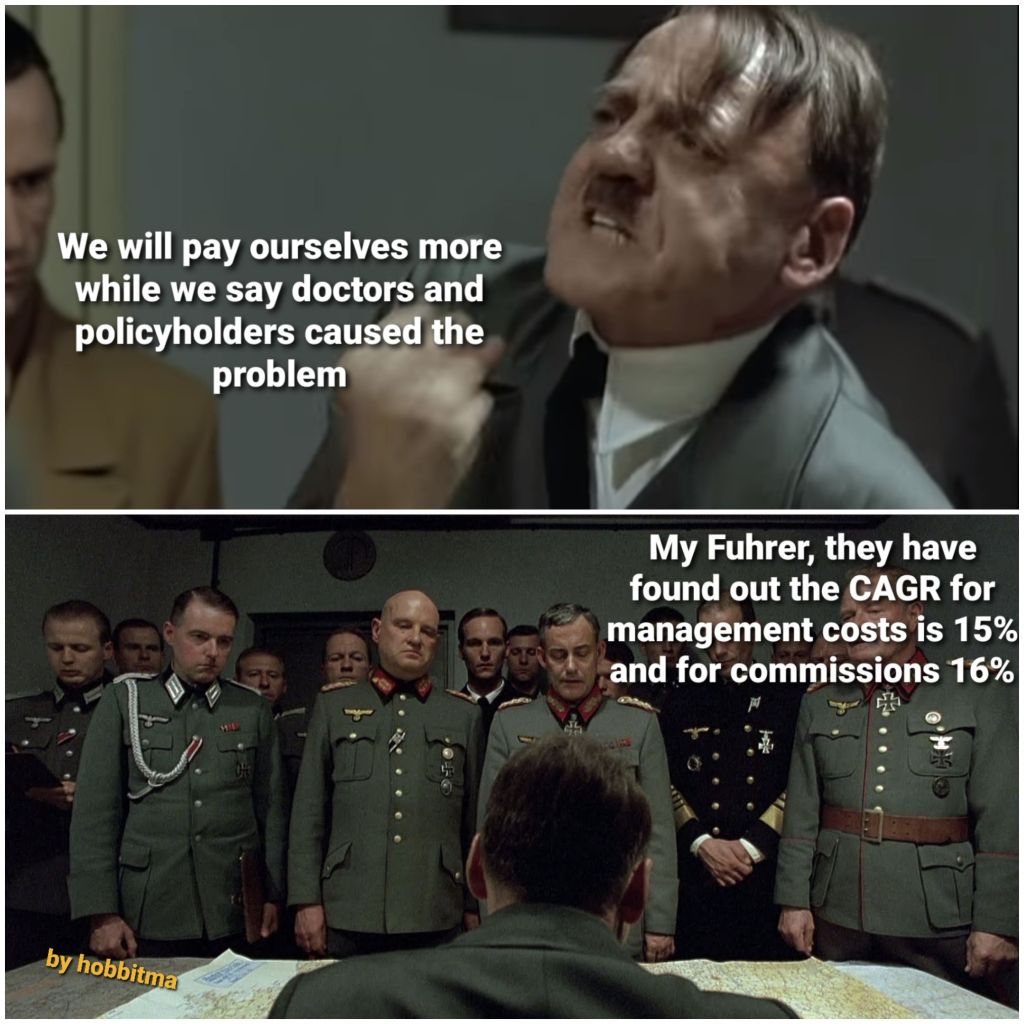
This is why a 15% to 16% CAGR for commissions and management costs is even more unconscionable and needs to be tackled aggressively and immediately.

So I don’t know what LIA is trying to say. Especially the LIA spokesman with his/her “there’s not a lot of fat” statement. There is a lot of fat in a 5 to 6 percentage point gap between commissions/management costs and premium CAGR!

Highlight #9: Rolling 3 Year CAGR from 2013 to 2019

LIA uses the tool of 3-year Rolling CAGR to bolster its argument that the phenomenon of “Growth in management expenses and distribution costs have generally lagged that of claims” (page 6, para 3), and this trend reversed in 2017.

It further stated in the next para. One possible explanation is that insurers started implementing the HITF recommendations, and incurred management expenses for doing so. At the same time, the implementation of these recommendations may have had the effect of moderating claims growth. If this is true, then on an overall basis, the HITF recommendations have had the beneficial effect of moderating overall cost growth”.

Except that this is not necessarily true. A 3-year Rolling CAGR includes data from the previous two years. For example, 2015 data actually includes data from 2013, 2014 and 2015, hence the term 3-year Rolling CAGR. It is important to look at absolute numbers but it is also important to look at the trend. As the saying goes “The Trend Is Your Friend”

The HITF Report was published in October 2016, which means that its recommendations will only have had any efficacious effect with effect from 2017 at the earliest, if not 2018.

Taking a closer look at Figure 3 on Page 7 will reveal that 3-year Rolling CAGR for Gross Claims have been falling quickly since 2015, and 2015 Includes data from 2013 and 2014. Whereas Commissions have been rising since 2017 (which includes data from 2015, and Management costs also rose sharply since 2018, which includes data from 2016.

In other words, the recent trends of declining 3-year CAGR for claims and the unfavourable trends for rising 3-year CAGR trends for commissions and 2016 for management costs started before HITF recommendations were implemented.

Chew on that, folks

Highlight #10: Will New IP Entrants Ever Reach Economies of Scale?

Page 6, Last Para:

“Another factor to consider is that 2016 and 2018 saw new entrants into the IP market. As new entrants have relatively small portfolios, they will tend to have higher management expenses as a fraction of premiums. In addition, distribution costs are higher for policyholders in the first year of a policy, as considerable work is involved in the inception of IP policies.”

The IP market is at a high of 70% market penetration already. Will more Singapore Residents buy IP such that the market penetration goes up much further? This hobbit thinks not.

In other words, new entrants will continue to have “relatively small portfolios” unless it can gain market share from other established players. This is unlikely unless these established players do not defend their turf and roll over and let the new players take their cheese.

The distribution costs (i.e. commissions) may come down as policies age, but certainly management costs will not come down much in this scenario.

This hobbit is glad that LIA has stated that they will share their findings on this matter “publicly”. Let’s wait and see then.

Highlight #11:  The Policyholder Should NOT Be Paying For Lack Of Economies Of Scale And Other Inefficiencies

Page 7, Para 2:

“it may not be appropriate to directly transplant Obamacare regulatory requirement of an 80-85% loss ratio to the Singapore context”.

LIA goes on to give several reasons why this is so, such as lack of economies of scale among local insurers when compared to USA ones and that health insurance premiums are much higher in USA.

It is true USA insurers are larger and have economies of scale. But unlike Singapore, there is practically no “voluntary downgrading” effect in USA. As stated in Parliament and SMA Position Statement, voluntary downgrading inadvertently consumes public healthcare resources and subsidises the IP insurers. This actually means that IP insurers already have more fat built into the system than American insurers.

American healthcare is one of the most litigious in the world and legal costs are factored into the premiums. On the other hand, we are nowhere as litigious as America and again IP insurers benefit from this.

In addition, Singapore is well known for our efficiency and cost-effectiveness. So why should we settle for a system that is even less efficient than the notoriously inefficient American healthcare system (i.e. less than 80 to 85% gross claims or medical claims ratio)?

This should again draw the spotlight again on the fact that perhaps there are too many IP insurers in a slow-growth market. Policyholders are in fact paying higher prices in a market that is not truly free, i.e. policyholders with pre-existing diseases who are stuck with the same insurers, and paying for insurers’ inefficiencies arising from their lack of scale.

Highlight #12: Who Is The REAL Misleading Party?

The LIA Industry Statement has a whole section devoted to this on page 2:

Misleading analysis should be avoided

“It is important that organisations put out objective analyses which avoid biased conclusions. In this regard, we find SMA’s analysis of insurers’ costs and claims costs to be misleading. Claim increases are the main driver of premium increases. LIA Singapore will fully address this in due course, along with more detailed comments on the rest of SMA’s position statement”.

If one reads the LIA’s Position Statement, LIA makes no serious attempt to prove that SMA has misled anyone in the SMA Position Statement. LIA has not managed to debunk the SAS data in any way. The SAS table remains correct down to the last digit and LIA did not contest the table’s figures when it could have. SMA’s numerical inferences (in the last two rows of the table, absolute & increase and CAGR) therefore remain consequently 100% correct.

What LIA has done is to offer an alternative perspective using a longer timeline (from 2010 instead of 2016) and to use 3-year Rolling CAGR. This hobbit has already addressed these two points earlier on. When we look at prices and costs, the importance of recentness is paramount. Please don’t tell me my kopi-O in SGH Houseman Canteen cost only 50 cents 20 years ago. That’s irrelevant to the pain or prices people are facing today.

In a valiant attempt to levy a false accusation against SMA, the LIA claimed that SMA’s position was that management costs and commissions were the main reasons why premiums were increasing. The SMA made no such claim. What the SMA said was “We (i.e. SMA) suggest that the IP industry should take a hard look at how it justifies its management and commission costs as the first step in ensuring the IP industry is sustainable” (SMA Position Statement, Para 26).

This was repeated again in Para. 27: “Instead of repeatedly lamenting that healthcare providers and policyholders are to blame for the losses incurred by some IP insurers through overconsumption, overservicing and overcharging, IP insurers should take the necessary steps to explore cutting their own management and commission costs to enhance the sustainability of the IP sector”

The biggest component of premiums is claims, but the biggest contributor to the lack of sustainability are the fastest growing components – management costs and commissions.

By conflating cost composition and unsustainability, it is LIA that is misleading.

In summary, SMA and LIA can argue whether using data from 2016 or 2010 is better, but there is nothing misleading about SMA’s analysis. The internal validity and external validity of SAS’s numbers and SMA’s elaboration on them remain intact and congruent.

Conclusion

This hobbit will end with this parable:

There was once a manager who wanted to buy lunch once a month for his team: a monthly team-building lunch for his five-member team.

He gives $100 to the office pantry aunty to do so. The aunty buys $75 worth of food and drinks for the team. She spends the rest on transport, such as taking the bus or even a taxi or car-hire services, which is of course necessary. The manager is kind and tells her to spend some of the remaining $25 on herself for a meal, which she duly does, such as buying a cup of tea and a bowl of noodles for lunch at the coffeeshop. Then, this aunty goes from eating noodles to economy rice (2 meats + 2 vegetables) and consumes more of the remaining $25. The manager doesn’t think much of this and thinks it fine too.

After a few more months, the manager finds out the pantry aunty is now treating herself to more and more things, such as a beer and even gourmet burgers and is taking premium car-hire services.

Finally, after a few more months, the pantry aunty now tells the manager that $100 is no longer enough, and she wants $110. But the amount actually spent to buy food and drinks for the five-member team remains at $75. Alternatively, the pantry aunty says she can live with $100 but then tells the manager that only $65 will be spent on food and drinks for the five-member team, down from $75.

What shall the manager and department do with this pantry aunty?


[1] Having more doctors on IP panels may lead to higher premiums: Life Insurance Association, The Straits Times, 2 April 21

A Commentary on SMA’s Position Paper on Troubled Integrated Shield Plans (IPs)

It is not every day that SMA hits the front page of three newspapers: The Straits Times, Business Times and Lianhe Zaobao. But that’s exactly what happened on 29 March 2021 in response to the abovementioned Position Paper. The paper was already released to SMA members I think about a day earlier.

The reporting on 29 March focused on “Future SMA Initiatives” which involves ranking of IP insurers and setting up of a SMA Complaints Committee for IPs and Health Insurance.

But this Hobbit thinks this this is not the real main thrust of the paper.

The main narrative of the paper is how and why we got to where we are, and draws a BIG question mark on whether IPs, the way it is structured, sold and managed, is sustainable at all.

Blameworthy or Blameless IP Insurers?

The first point made in the paper is to debunk the narrative that doctors and patients are the chief cause for overservicing, overcharging and overconsumption that are seen more commonly in as-charged plans and comprehensive first-dollar riders. They are bad, but the SMA puts a large part of the blame back at the IP insurers who first offered these insurance products. SMA is right. The IP insurers narrative of assigning blame to doctors and patients is like saying the cigarette companies are complaining about rising rates of lung cancer amongst smokers and blaming the smokers for this and that the cigarette companies who created and sold the cigarettes are themselves blameless.

The HITF Report Recommendations

The SMA clearly draws the line in the sand with how it sees the Health Insurance Task Force (HITF) Report’s recommendations vis a vis LIA.

In her letter to the ST Forum on 18 March, The Life Insurance Association’s Executive Director, Ms Pauline stated that “The HITF, which included the SMA, recommended a suite of measures to do so, including panels, pre-authorisation, fee benchmarks and co-pays”, in an apparent attempt to infer what the IP insurers are doing has/had the blessings of SMA through both parties’ membership in the HITF.

In this Position Paper barely 10 days later, the SMA resolutely states (para 18) “the SMA council wishes to make clear that it is unable to support the way how the LIA and many of its members have implemented these recommendations”.

It is clear that from SMA’s perspective, LIA and many of its members have misinterpreted and misapplied the HITF recommendations. Which party is right here? This is a point that is worth mulling over.

The Cookie Monster

This is going to take a bit longer to explain but please bear with this Hobbit. The HITF was formed in 2016 and the Report released in October 2016. Buttressing this Report is a 26-Page “LIA Study On the Cost Of Health Insurance In Singapore” (Annex D of HITF Report). It is with this study that LIA made the case that healthcare costs with respect to IPs were increasing at an alarming pace and measures to control this increase were urgent and necessary. The Study used data mainly from 2012 to 2014, a three-year period or a Compound Annual Growth Rate (CAGR) over 2 years.

Now what did this LIA Study actually say?

For the study period, it showed that IP inpatient bill sizes increased by a CAGR of 8.1% vs 2.1% for A class beds in Restructured Hospitals (Page 8: Table 1). According to LIA, this 8.1% is a very bad thing.

The Study then broke down the inpatient bill further into Room and Board Charges, Surgery Charges and Implant Charges (Page 11: Chart H). The CAGR for the same period (2012 to 2014) for the three categories were 8%, 10% and 13% respectively for private hospitals. The corresponding figures for A class were 4%, 1% and 0%. Doctors are responsible for surgery charges and 10% CAGR was held up to be a very bad thing as well.

So this was the starting point or platform for the HITF which the LIA had constructed in 2015. They obviously did their homework and credit must be given when credit is due.

Unfortunately, they stopped their homework after the HITF Report was published. Or at least if they didn’t, they chose to ignore some very significant and odious trends that were building up post-LIA Study (2015) and post-HITF Report (2016).

They probably thought everyone bought their “Insurers are sibeh cham” narrative. As recently as 18 March, in the aforementioned letter to ST Forum, Ms Pauline Lim mentioned, “(the HITF measures) are collectively intended to address overcharging, overservicing and overconsumption of healthcare services”. She was implying clearly that the HITF recommendations (implemented in the manner that LIA’s members see fit) were necessary because the three evils of overcharging, overservicing and overconsumption still existed.

Then came the Singapore Actuarial Society’s 100 mega-ton warhead “SAS Comments: Medishield Life 2020 Review” document (https://actuaries.org.sg/sites/default/files/2021-01/SASResponseMSHLReview2020FINAL.pdf)  which was published just in January this year. The Review used more recent data and a longer period covering 2016 to 2019.

It countered LIA’s claim that (at least in this period) there was overcharging, because Average Payout Per Claim went down by 1% (not up!) over this period.

It also completely countered LIA’s claim there was overservicing because the claims incidence rate for IPs (9%) was actually 1% lower than for Medishield Life (10%). It is noteworthy that this is a good comparison because Medishield Life (and Medishield before this) is well designed with copayment and deductibles being a part of the product design as compared to the as-charged and comprehensive riders being offered by IP insurers in the past

Overconsumption = overcharging X overservicing.

If there is neither overcharging nor overservicing, then it is nigh impossible to have overconsumption.

But hang on folks. There is more.

From the table given in SAS’ Comments (Page 20: Table A4), it can be inferred that the CAGR in Management Fees (16%) and Commissions (15%) were growing at much faster rates than that of Gross Premiums (10%) and Gross Claims (11%).

Gosh, how the tables have turned! The 16% and 15% are much higher than the numbers used in the 2015 LIA Study to justify their call to control doctors’ fees (10% for 2012 to 2014)  through fee benchmarking and over-provision of services through panelling and pre-authorisation. This hobbit won’t say it’s disgraceful, but these figures collectively interpreted are pretty embarrassing for LIA.

In case anyone thinks that a few percentage points do not make a big difference, please note these are COMPOUNDED rates, and they tend to have a multiplicative, explosive effect with time. This can be seen by the fact that Gross Claims increased absolutely by 35.9% over four years (when its CAGR was 11%) and Management Expenses increased absolutely by 56.6% (when its CAGR was 16%). A five-point CAGR difference translates into an absolute 20.7% difference over a four-year period. And this absolute difference will increase more rapidly with time as long as the gap exists.

As it turns out, the SAS Comments paper have revealed why there seemingly aren’t enough cookies in the jar – there is a cookie monster helping itself to more and more cookies. And the greatest irony is that the one party complaining most loudly and frequently about not enough cookies is the cookie monster itself!!!

Expensive Tradeoff Between Risk-Pooling And Cost Of Running IP

Another snippet is that that Gross Claims accounted for 75% of gross premiums collected. This means for every four dollars collected, one dollar goes to non-healthcare cost items. Insurance, at its core, is a construct that is supposed to extract more funding efficiency through risk-pooling. But if the “funding efficiency” is only 75% (i.e. only 75% goes to healthcare providers to pay for healthcare), one must wonder is this risk-pooling worth the bother at all. In the Affordable Care Act (i.e. Obamacare), it is mandated that 80% to 85% of premiums must go to healthcare providers, so as to maintain a baseline efficiency in the system. This is also why SMA calls for a 85% to 90% Gross Claims figure to be imposed on IP insurers so as to “instill cost discipline”.

One Payor To Rule Them All

Which leads us to the last point SMA was trying to make – the prospect of a single-payor system that can extract far more efficiency than the current IP sector involving seven players. In 2019, $363M was spent on management costs and commissions. This is a huge sum. If a single payor can run the whole IP system for say $63M, that is $300M in savings. This hobbit is told $300M is the ballpark figure a ‘smaller’ restructured general hospital receives in operational subsidies a year. In other words, the savings so gained can be used to fund another general hospital the size of KTPH or maybe even NTFGH. Alternatively, the money can be put into Medifund to help poor patients in the subsidised healthcare sector. This hobbit can think of no better single payor system operator than MOH. If MOH can run Medishield Life, it can certainly run IPs.

The counter argument to all this is that market competition is good and market forces must be allowed to play themselves out. But as experience has shown, the IP market is hugely imperfect as policyholders cannot freely switch IP insurers once they have pre-existing disease(s). That is why IP insurers can raise their share of the pie in terms of management costs and commissions with relative impunity.

Bad Apples and Dirty Linen

Finally, we come to some of the concerns raised about SMA’s big pushback against IP insurers. People are concerned that with SMA’s Position Paper, the LIA, its members or just their sympathizers will push back with horror stories of unethical doctors overcharging, overservicing etc. In other words, they will publicise all our bad apples and wash our dirty linen in public.

There are some 2000 specialists in the private sector and there will always be bad apples to show and dirty linen to wash. In fact, this hobbit knows quite a few examples too. But that is NOT the point. No matter how many bad apples we have (and this hobbit would like to think there are but a few) and dirty linen to wash, they are ALL encapsulated in the 11% CAGR in Gross Claims. That’s it.

This 11% is just one percentage point higher than the CAGR for Gross Premiums. It means that Gross Claims growth is very close to growing in tandem with Gross Premiums, which is the first precondition to making the IP environment financially sustainable. Now contrast this 11% to the 15% to 16% figures for commission and management costs and one will quickly realise who is the main culprit in this whole issue of IP sector being unsustainable.

Conclusion

The 15% to 16% CAGR for commissions and management costs makes IP unsustainable. Period. Extracting more friction through pre-authorisation, higher deductibles and copayment when using non-panel doctors or having highly restrictive panels won’t address the root cause of the problem. Reimbursing doctors at even lower rates than now may help, but at current rates how much lower can you go? MOH might as well throw in the towel and concede defeat to LIA and its members by withdrawing its Fee Benchmarks if the IP insurer fee scales go any much lower than now.

The SMA Position Paper highlights the findings of the SAS Comments on Medishield Life, and points the way to where we should look for solutions. With payout size stable and claims incidence rate for IP being 1% lower than Medishield Life, the focus of efforts to make IP sustainable must now be on the IP insurers themselves.

The numbers don’t lie….

The 6ME FDW or Maid Check-up

The recent case of the tragic death of a Myanmese maid has led to calls for doctors to be tasked to report cases of maid abuse. Actually this requirement already exists, in small print, in the current form after the doctor ticks off the results for the VDRL and pregnancy tests:

“If you notice signs of abuse, refer the helper immediately to the Police or MOM for help”.

It was also noted that “the doctor had seen bruises around the maid’s eye sockets and cheeks, but Gaiyathiri (the late maid’s employer) claimed that the victim fell down frequently as she was clumsy” (CNA website, 25 Feb 2020; Myanmar maid’s death: MOM reviewing how doctors report potential abuse). It was also reported that Gaiyathiri turned down the doctor’s suggestion for further tests on the victim’s swollen legs in case of underlying conditions.

MOM said “Nothing adverse was flagged to the authorities’ attention on either occasion (when the doctor saw the deceased maid)”.

This hobbit is all for doctors’ playing a greater role in the detection of foreign domestic worker abuse. But to go beyond the present state of affairs, we need to answer a few questions.

The first question that needs to be answered is whether the doctor is supposed to detect abuse in this statutory medical examination using clinical examination or forensic examination methods?

Let us first talk about statutory medical examination. A statutory medical examination is simply a medical consultation and physical examination (and sometimes includes investigations) to demonstrate that the examinee is fit for a purpose as required by law (i.e. statute). Examples include heavy vehicle examination, pilot examination etc. The Six-monthly medical examination (6ME) for foreign domestic worker (FDW) required by MOM is another such example.

The purpose of this examination when it was first instituted was to detect if a FDW was pregnant or if the FDW had contracted sexually transmitted diseases. These questions can easily be answered objectively and in a binary fashion (yes or no) by simple laboratory tests.

Detecting abuse was a later addition to the 6ME that was added on only a few years ago. The case for detecting physical abuse is slightly different. There are no simple laboratory tests with binary outcomes for physical abuse. It is a matter of judgement and therefore more subjective.

Every doctor is trained to conduct a clinical examination. However the clinical examination is based on certain assumptions of a social compact between the patient and the doctor. A clinical examination entails history-taking and physical examination to elicit clinical signs and symptoms. Undergirding this is that the patient must cooperate by telling the truth. I think all doctors would have had the unfortunate experience of being waylaid to some extent by patients not telling the whole truth after many years of practice.

A forensic examination is different. The underlying principle here is that the doctor is trying detect some crime that has been committed. The patient should preferably cooperate with the doctor but the forensic examination is not dependent on this cooperation. After all, a forensic medical examination is a comprehensive examination looking for injuries and taking samples that may be used as evidence in a police investigation and any subsequent prosecution. Doctors will have to be trained to perform forensic examinations if this is the standard expected of them in the 6ME.

It would be helpful if MOM can state if they expect doctors to conduct a clinical or forensic examination when they carry out the 6ME FDW.

Be it clinical or forensic examination, a key point is that the employer or any other person should not be present, if the intent is to detect abuse. However, there is no such stated requirement now, despite the fact that the doctor is to refer the maid to the Police or MOM if the doctor notices “signs of abuse”. It is hard to do a proper examination to detect abuse when the criminal may be right there standing next to the abused. The doctor is also not empowered by statute to confirm his suspicions of abuse by ordering tests.

A second and equally difficult question is how will a doctor be judged? If there is truly abuse and a doctor missed it, to borrow a legal term, what is the “burden of proof” that will be applied to the doctor?

There are three common standards used:

  • Prima facie, i.e. enough evidence to support a case
  • On the balance of probabilities
  • Beyond reasonable doubt

Is a doctor supposed to report abuse because

  • There is just some evidence that the event happened? (“prima facie”)
  • More likely than not that the event happened (50.1% probability that something happened)
  • Very strong evidence that the event happened (beyond reasonable doubt)

If the doctor is informed beforehand what is the applicable standard, then the doctor will also likewise respond appropriately to the standard expected of him or her.

The third question is that of costs. Presently, a 6ME costs anything from the region of $25 to $45 (depending on whether you use urine or blood to detect HCG). In reality, most doctors do nothing more than a cursory physical examination and the whole process takes 5 to 10 minutes or so. A detailed clinical examination (let alone a forensic one) will entail far more time and resources than what is presented committed to the 6ME. It would also mean employers have to probably pay a higher price for the 6ME. But if society is determined is stamp out maid abuse, then it must be so.

Integrated Shield Plans: The Veneer Of Choice

Empanelling: Trust Me, You Will Take The Blue Pill

Over the last few days, a series of letters to The Straits Times Forum has appeared that commented on some of the choice-limiting practices of Integrated Shield Plan (IP) insurers. (Mr Tan Siak Khian, 19 and 24 Feb 2021; Dr Tony Ho, 22 Feb 2021)

It deals with the “restrictions” placed on IP policyholders’ choice of doctors when they use their IPs. To be fair, there are no “hard” restrictions – every IP insurer will tell you (and the regulators) that policyholders can still see the private specialist they want, subject to certain processes and approvals being obtained. There are no hard restrictions or outright bans on seeing an “un-panelled” private specialist for a certain condition or procedure that is covered by the IP.

In short, the system is designed to impose “friction” on the policyholder, such that the policyholder is “disincentivised” from seeing a non-panel doctor. The policyholder has to jump through a number of hoops before he has access to the doctor he wants. These hoops include coming up with a cash deposit himself that the IP insurer will probably (not 100% guarantee) reimburse later, the non-panel doctor has to seek pre-approval by filling up a long form trying to justify the procedure and include more than enough information necessary for a pre-approval to be processed.

Added to all this friction is the ultimate deterrent – the need for cold, hard cash. The Straits Times Invest Editor, Tan Ooi Boon highlighted this “When cash is needed for those big hospital bills” on 28 Feb 2021. The column highlights the burden that IP insurers pile on policyholders when they see non-panelled doctors by issuing Letters of Guarantee (LOGs) that may not cover big hospital bills and the policyholder has to fork out the remainder while the claim is processed (with no guarantee the claim will be fully paid).

The whole process is designed to sow fear and uncertainty in the policyholder and to inconvenience him to the point that he chooses a panel doctor. In other words, although there are no hard restrictions as to what doctor you can see, the system is designed so that you, the policyholder, is likely to cave-in to the IP insurer’s preferences and use a panel doctor. Please note, it is not a demand, as in a hard requirement, but a preference of the IP insurer. But for this to happen, the policyholder must cave-in, and believe you me, the insurers are very good at making you cave-in. It’s like the movie Matrix, no one forces you to take the blue pill, but by jolly, they make it so tough for you to take the red pill that you cave-in and take the blue pill. But they will tell you it’s your choice that you did not take the red pill. No one really forced you. This hobbit calls this the veneer of choice or pseudo-choice.

Half the IP insurers claim to have lost money on IPs in 2019. Some have lost for several years. In the business world, if you lose money in a certain business segment for a few years you will think about exiting this segment. But no one has done so. No one has even threatened to do so. That means either they are very charitable or something else is afoot.

Nothing Personal, It’s Just Business

In Malaysia, it is very difficult to buy personal hospital insurance unless you also buy a life insurance product. The two are usually ‘bundled’. This is because life insurance products are almost always profitable while personal hospital or healthcare insurance may not be. But personal hospital or healthcare insurance is a ‘loss leader’; i.e. the insurance company accepts that it will likely make losses in this segment but he will make money in the life insurance bit.

Here, there is no bundling, but it may be that insurance companies want to enter the IP segment so that they offer a complete suite of products and services so that they can sell more insurance policies in the profitable segments. This hobbit really doesn’t know, to be honest.

A blogger has examined the IP industry and have commented that neither ‘kiasu’ patients and greedy doctors are to blame of IP insurers losing money. The blogger has written twice on this topic. Go to lifefinance.com.sg. It’s all there. It’s a treasure trove of information and analysis about IPs.

Basically the blogger concluded that IP insurers are in the red mainly because of:

  • Lack of economies of scale
  • High management costs
  • High distribution costs (what insurance agents and financial advisors earn from selling IPs)
  • An ageing population. (The ‘first’ generation of IP policyholders are now nearing 60)

The blogger further stated there is no clear evidence that doctors’ fees is the main cause of the IP as losses the claims ratio is manageable. In fact between 2016 to 2019 the average pay-out per claim fell by 1% per year!

A note to add here is that management costs is a highly variable thing. It can be high because of inefficient management, or inappropriate cost apportionment or that people are simply paid too well to run the IP business. Claims ratio is an objective measure. Claims ratio is a measure of how much is paid out as claims as a ratio of premiums collected. Distribution costs is what is actually paid to the insurance agents and hence is also a more objective measure.

But the fact that no IP insurer has exited the IP segment because of repeated losses implies that IP business can well be a loss leader. Or that the losses are simply due to apportionment of costs which could be accounted for somewhere else. Food for thought.

Further food for thought is what if an IP insurer actually exits the scene? Let’s say company IP X exits the business. What will happen? For a start, all of the folks who bought IPs from IP X now have no IP cover after their current contracts expire. IP policies are bought and renewed on an annual basis. These folks would have no cover in months. Can they buy from another IP insurer? The answer is yes. But it is a BIG conditional yes. The new IP insurer is under no compunction to cover for any pre-existing disease that the policyholder had developed during the time he was covered by IP X. Healthy policyholders may not be affected adversely as they can get an IP from another insurer easily, but those with pre-existing diseases may experience the following

  • Loading of premiums for pre-existing diseases
  • Denial of coverage for pre-existing diseases
  • Unable to buy an IP altogether  

This hobbit hopes the regulators have drawer plans in place for this scenario so that IP policyholders are not left high and dry.

LIA’s Letter to ST Forum

On 27 February 2021, The Life Insurance Association (LIA) of Singapore’s Executive Director replied in The ST Forum to the three letters. This hobbit has reproduced the entire letter here from the 3rd paragraph onwards (in bold and italics). The first two paragraphs are really administrative in nature. Like how a histopathologist examines a space occupying lesion excised for suspected cancer, slide by slide, this hobbit examines this letter paragraph by paragraph and also asks some inconvenient questions.

3          Integrated Shield Plan (IP) insurers have an interest in ensuring that their panels are comprehensive, as this increases panel usage and helps IP insurers better manage costs. In line with this, insurers are continuing to expand their panels.

Comment: Not really true. Data shows that each IP insurer have only about 20% of private specialists on their panels. Even if an insurer double the panel size it would be only 40%. Insurers do not make money by having comprehensive panels. Some insurance companies promise panel doctors large volumes of work in return for low doctor fees. Small panels shift the balance of bargaining power from the panel doctor to the insurer and the insurer can extract lower and lower fees by promising more and more work to a small group of doctors.  Can LIA recommend a target for its members – like what percentage of private specialists should be on an IP panel?

4          Life Insurance Association (LIA) Singapore has also provided guidelines on the implementation of preferred healthcare panels, which includes the need to ensure that the network is sufficient to offer a wide range of medical services to policyholders.

Comment: The original document that recommended panels was in the Health Insurance Task Force (HITF) Report. It stated “To enhance and ensure transparency of the arrangement (e.g. disclosures on the healthcare provider selection process)”.  I.e. IP insurers should state the criteria used to select doctors to be on a panel.

To date, not one insurer has disclosed what is the selection criteria for healthcare providers (i.e. why a doctor is selected to be on a panel while another is not). Can LIA make its members (i.e. IP insurers) come clean on what is the selection criteria and remove this opacity? Not just general statements about criteria etc but actual quantitative or qualitative measures that make up these (now secret) criteria.

5          Mr Tan asked what happens if a doctor is removed from the panel. IP insurers generally decide to remove doctors from a panel only as a last resort or in extreme circumstances. Should removal of a doctor be necessary, an adequately long notice period will be given to allow patients to transition to another doctor, should they wish to do so.

6          Doctors may also choose to leave panels for various reasons, and this is not within the control of IP insurers. Should there be transfers of care, doctors are professionally obliged to provide sufficient documentary medical information to enable continued quality care.

Comments: It is true that that IP insurers seldom remove a doctor from the panel. But the whole point is not whether a doctor is removed, but rather if the panel was adequately constituted in the first place! If you start off with 20% of private sector doctors then it is manifestly inadequate even if you do not remove any doctors from any panel.

The Executive Director then tries to give the impression that a significant root cause of the problem is that  doctors choose to leave panels voluntarily. Doctors leave for one reason and one reason alone – the IP insurer is paying badly. If you reimburse at below or at only the lower end of the fee benchmarks, then some doctors may and will leave. Why would a doctor otherwise leave when being a panel doctor usually means more work and more earnings?

This hobbit has not heard of anyone wanting to leave NTUC Income’s panel. This is because NTUC Income pays the doctor as long as he charges within the entire range of MOH’s fee benchmarks. Doctors will leave panels because they perceive the insurer is not giving them a fair deal.

7          Mr Tan also asked whether there are checks in place to ensure insurers do not make unfair changes to terms of contract.

8          IP insurers do not make changes to their insurance contracts lightly, particularly when it comes to changes that affect in-force customers, and such changes go through extensive internal review.

9          In addition, all contractual changes to IPs must be approved by the Ministry of Health.

Comments: This is technically true and the policyholder is apparently protected. But again in real life it is not so. If the contract is well constructed then the policyholder is protected. But if the contract is lax and amorphous then good luck. Which is exactly what happened when Aviva unilaterally stopped coverage of diagnostic scopes in its IP Plans. The contract was so loosely worded that it could do so (i.e. not reimburse for diagnostic scopes) without changing contract terms. This incident showed that Aviva (and by extension, any other IP insurer) could withdraw coverage for something as fundamental as diagnostic scopes without changing its contractual obligations. Chew on that, folks.

10        Finally, the Monetary Authority of Singapore requires representatives to disclose at point of sale that IP and rider contract terms allow insurers to change the terms and conditions. IP insurers must notify policyholders before doing so.

Comments: I hope MAS is enforcing this through routine checks. For a start it could send in some “mystery shoppers” to purportedly buy IPs and see if the agents are doing so. Also please note that LIA has said that contractual terms cannot be changed without MOH’s approval but insurers can change terms and conditions. This hobbit doesn’t really know what this means in real life. Maybe someone can educate the public on this oddity.

11        LIA Singapore and IP insurers are committed to playing our part in ensuring the continued accessibility of healthcare in Singapore.

12        We urge all parties involved to play their part, too.

Comments: On the bright side, this hobbit suspects that 2020 was a good year for IP insurers. This is because in Covid-stricken 2020, people generally loathed going to hospitals. Healthcare-seeking behaviour changed drastically as people feared getting infected with Covid-19 at healthcare facilities. Many electives were postponed and people only sought urgent or emergency care and absolutely essential care in 2020. In all likelihood claims ratios will drop even further while IP insurers continued to collect premiums.

Can LIA “play their part” by cutting 2021 premiums?   Please don’t  pocket all and return some of the 2020 profits to the policyholders? Please…..?

Summary

In summary, doctors in the private sector have long known how the IP insurers behave to stack odds in their favour. There is little trust between them and the IP insurers. In fact, this hobbit would say there is no love lost between the two.

Of course, in defence, IP insurers will highlight how some specialists have “over-charged” in the past but this issue is now already dealt with by the MOH Fee Benchmarks. In any case, “overcharging” became commoner after the SMA Guideline of Fees (GOF) were removed reluctantly by SMA because the government had outlawed such guidelines. The SMA had warned everyone about the negative consequences of withdrawing the GOF to no avail. You can’t just lay 100% of the blame on doctors. The regulators allowed such an (GOF-less and benchmark-less) environment to exist which led to rapidly increasing doctors’ fees between 2007 and 2016.

Private sector doctors saw how some insurers seemingly took and twisted the recommendations of the HITF Report to their maximal benefit. Having small panels and reimbursing below MOH Fee Benchmarks are two such examples.

Some have said this is akin to religious extremists twisting and contorting mainstream orthodox religious teachings to their own benefit, but this hobbit readily admits this is too serious a charge to levy on IP insurers. IP insurers are not extremist. They are probably just profit-maximising, business people.

But now the public have also gotten wind of these practices and now realise they too could well be receiving the short end of the stick.

IP insurers should know that losing the trust of doctors is one thing, but losing the trust and confidence of consumers is another thing altogether. Trust is hard-earned but easily lost in the twinkle of an eye.

I hope regulators empathise with the patient, because obviously we should not trust IP insurers to, going by past behaviour. In the current climate, the only real choice the patient has is to decide whether he should buy an IP or not and which IP to buy. After that he only has the veneer of choice or “pseudo-choice”, or no choice at all:

  • He falls sick and it is not a choice to fall sick (assuming he led a reasonably healthy lifestyle)
  • He can technically choose a specialist, but in reality he has to choose from a very limited panel of specialists (pseudo-choice) even if the specialist he prefers charges responsibly (according to MOH Fee Benchmarks)
  • He grows old and develops pre-existing conditions (not a choice) and he cannot switch IP insurers unless he incurs significant additional costs or suffers penalties (pseudo-choice)

Finally, some say light is the best disinfectant and indeed the IPs offered by insurers can benefit from much more light indeed. Independent bloggers such as those in lifefinance.com.sg and journalists such as Mr Tan Ooi Boon play an important role in educating the public about the whole IP milieu which is hitherto shrouded in jargon and complexity. People always talk about reducing the information asymmetry between doctors and patients. It is also time now to reduce the information asymmetry between IP insurers and patients as well.

Let there be light.

2021 Hobbit Awards

2020 was a year with no comparison for healthcare. Of course, Covid-19 was the every visible elephant in the room but there were other memorable incidents and people that managed to share some of the limelight as well. This hobbit recaps this momentous year with the 2021 Hobbit Awards. And the winners are……

Circular King Award

A total of 244 Circulars were issued by MOH in 2020. They were issued by either our new DMS, Prof Kenneth Mak or his lieutenants. If you think about it, there are 366 days in 2020 (leap year), 104 weekend-days and 11 public holidays. That leaves us with about 251 working days (give or take a few). In other words, we had to keep abreast with about one new MOH circular per working day! That’s incredible. I think the current DMS has issued more circulars in one year than any of his predecessors. He is this hobbit’s choice for Circular King Award.

Superman Baby Award

In the beginning of every version of a Superman movie, the opening scenes invariably involve the parents of Superman putting the Superman baby into a spacecraft. The spacecraft then blasts off planet Krypton for Earth and within seconds Krypton explodes.

That about sums up the previous DMS, Prof Benjamin Ong. The first case of Covid-19 hit Singapore on 23 Jan 20. His last day in MOH as DMS was 31 Jan before the current DMS took over and MOH promptly exploded with the Covid-19 outbreak in Singapore. Prof Ong is a deserving winner of the Superman Baby Award.

Best Communication Award

This goes to our wordsmiths in the civil service and political leadership for coming up with the term “Circuit Breaker” in lieu of the commonly used “lockdown”. The acronym “CB” is now widely used. More interestingly, on 21 Apr 20, it was officially announced that CB measures would be tightened. Only in Singapore do we tighten already a very tight CB.

Most Useless Relic Award

Remember long, long ago, in a galaxy far, far away, there was this one colour code to rule them all – DORSCON? Well nobody talks about it anymore. Although it has a few colour grades to the Code, no one takes it seriously when we realised ‘Red’ is a hypothetical, mythological colour that will NEVER be used even when we faced the closest thing to Armageddon (aka a tightened CB – please see above) and more than a thousand new Covid-19 cases were popping up a day.

DORSCON should be thrown into the fires of Mount Doom to be destroyed forever like all useless relics.

Best Witchcraft Award

This prestigious award goes to the Ministry of Trade and Industry’s GoBusiness Portal for deciding in an incomprehensible and opaque way who is an essential worker and how many staff is a clinic entitled to. How is a GP clinic assistant deemed to be an unessential worker is just beyond this hobbit.

Animal Advocate of the Year Award

This goes to the genius that decided that “basic” pet grooming services could resume on 1 June 2020, even before the resumption of “human” aesthetic medicine.

Best Cartoon Comedy Award

This award undoubtedly goes to the folks who approved the Virus Vanguard, who existed for about a day before it was disbanded. Even so, the timeless superhero legends of Circuit Breaker, MAWA Man, Care-Leh Dee, Dr Disinfector and Fake News Buster will remain etched in the collective psyches of Singaporeans forever. It shows that some decision makers in the government have a (strange?) sense of humour/reality.

This hobbit confesses that he may still be suffering from Virus Vanguard’s Dissolution-related PTSD.

The Special Destiny Award

This goes to the Minister for Manpower and her team for pitching to us the seminal point that the outbreaks in our foreign worker dormitories were inevitable. This hobbit now believes that we were just fulfilling our destiny when 47% of workers (152,794) living in foreign worker dormitories were infected.

Best Educator Award

This definitely goes to Minister Chan Chun Sing for educating a younger generation of Singaporeans on the use of the term “sia suay”. Even an old coot like me hasn’t used that in a long time.

He also educated us on the unnecessary use of masks and hoarding of toilet paper, eggs and instant noodles, amongst other things.

Evidence-Based Infection Control Award

This very relevant and timely Award goes to the Elections Department of Singapore for demonstrating with strong evidence during General Elections 2020 what most healthcare workers already knew – you can’t put on gloves when your hands are wet with disinfectant/alcohol/water etc.

Best Voodoo Healthcare Award

This goes to the Health Insurance industry, in particular the Integrated Plan (IP) providers for

  • Not respecting fee benchmarks that were issued by MOH
  • Selling IPs to 70% of Singaporeans when the combined hospital beds market share of private hospitals and A and B1 bed classes restructured hospitals is only about half of that
  • Empanelling only about 20% of specialists in the private sector and not telling potential IP customers that they can only choose from a very limited pool of specialists.

On the other hand, they are still telling the public to buy more IPs when there is really no capacity to fulfil demand down the road.

If this isn’t voodoo healthcare, this hobbit doesn’t know what is.

Company of the Year Award

DoctorsXdentists (DXD) won this hands down. In this one year, they managed to achieve the following:

  • Misrepresented MOH compliance officials
  • Irritated the hell out of several professional bodies such as Academy of Medicine, SMA and CFPS
  • Used information from the SMC doctors’ directory without SMC permission

This is the most breath-taking healthcare company we have seen in a long time.

The Basket Case of Doctorxdentist (DXD)

The dust looks to have settled for now with the DoctorxDentist (DXD) saga.  On 27 Nov 20, Senior Minister of State Dr Koh Poh Koon posted this on his Facebook account:

“Many of my medical colleagues have been troubled by the methods adopted by DoctorXDentist (DxD) to promote doctors who paid for their services. It is also unclear whether some of the patient “reviews” on the DxD website are genuine and consistent with the relevant rules and regulations. Following discussions with the Ministry of Health, Singapore, Singapore Medical Association and Singapore Medical Council, DxD will now remove all doctors and dentists from their website listing unless the doctor or dentist has opted in.

MOH and SMC are continuing to monitor the situation and will make further investigations into the DxD website where appropriate. We will not hesitate to take further action if necessary. We must safeguard the integrity of the profession and protect the interests of patients”.

I hope this will draw to a close to this rather tiresome if not vexing Search Engine Optimisation (SEO) company’s past distasteful practices which they claimed to have discontinued on 22 Nov (as reported on their website). DXD has said it will now adopt an opt-in model where it will only publish names of those doctors and dentists that opt-in to collaborate with them. It stated, “All medical professionals who do not wish to be on the Find A Doctor directory will have their entire profile removed”. On 26 Nov, DXD also said it will remove all patient feedback and ratings.

Now if only DXD adopted this reasonable position from the beginning, then all this gnashing of teeth and clenching of fists would not have been necessary.

Nonetheless, even as DXD has now apparently adopted a new and reasonable position to continue their business, it is instructive to recap what it did in the last few weeks and months to incur so much indignation from the authorities and the medical community.

Let’s now have a short curious case-study of the DXD…..

An overbearing attitude that dismisses a doctor’s rights to non-association with DXD.

It claimed (as stated in the previous post) that its mission overrides a doctor’s rights to non-association. Clearly a preposterous position for a privately-owned company to adopt, given the fact it is not a regulatory authority backed by the force of specific legislation.

Instant “ownself give ownself” mandate to be the patient’s champion

As stated also in the previous post, the co-founder of DXD, a certain Tristan Hahner replied to a doctor with these words earlier in the year, ““We are required to list all doctors practicing in Singapore. In other words, our directory has to be complete in order not to mislead patients. We are allowed to display factual information available in the public directory of the Singapore Medical Council without your explicit consent”.

We now know with some certainty after clarifications from MOH, SMC and SMA that no-one required them to list all the doctors. DXD probably “ownself require ownself” and tried to give the impression that they had a “mandate from heaven”, so to speak. Until SMA called their bluff. The misleading party here is indeed DXD, by claiming that they are required to do something when they cannot give any evidence of who this requiring entity is.

Their repeated use of the word “our patients” in their communications is also very disconcerting. It implies that they actually have patients when they don’t. The fact is, when someone or some facility claims to have patients, it means that these persons or entities owe a professional duty of care to these “patients”. But this understanding must be bilateral. This hobbit thinks DXD doesn’t know what they are talking about and it’s all fluff and bluff. After all, does the “patient” even think or agree that DXD owes him a duty of care? Even for a doctor – he can’t just pick someone from the street and declare unilaterally this someone to be his patient and he owes this patient a duty of care unless this someone agrees that “Yes, Dr X is my doctor” and therefore Dr X owes this patient a duty of care.

Misrepresentation of MOH’s position

If there is one raw nerve that civil servants have – it is to be misquoted or misrepresented. DXD’s early statements claim that they have arrived at their position of compulsory inclusion of all doctors and dentists on their DXD directory after consultation with MOH’s compliance officers. With MOH’s clarification to the contrary (MOH website 20 Nov 20), this is obviously untrue.

Refusal to issue an erratum, let alone apologise

To-date, despite MOH’s request for DXD to publish the erratum on 17 Nov, DXD has yet to do so. This gave MOH and SMC no choice but to publish the erratum on their own websites on 20 Nov 20 respectively. Frankly, if I were the Health Minister, I would have thrown the POFMA (POFMA – Protection of Online Falsehoods and Manipulation Act) at DXD in the face of such defiance.

Flip-flopping

DXD can flip their position faster than a prata.

Incident 1:

On 7 Nov, DXD said in Update 4 that it will be “removing all doctors who have requested to be delisted”. But on 14 Nov, it said it will “republish” these delisted names

Then, to add insult to injury, in a Business Times article (20 Nov 20), their General Manager Ms Tyr A Ding was reported to have said, “But after a closed door meeting with representatives from SMA, SMC and MOH, Ms Ding on Sunday told BT that the company has made a determined decision not to delist any private doctors” from its platform”. She was quoted as having said, “This decision is ours alone, and was made on a sound legal basis”.

22 Nov 20, DXD announces it will remove all names that request so. What happened to “determined decision not to delist…” and “This decision is ours alone, and was made on a sound legal basis”? Tsk tsk. Malu Sial.

Incident 2:

On 10 Nov 20, DXD announced that they will be publishing the full minutes of a meeting that was to be held on 13 Nov with MOH and SMA. On 13 Nov, they stated that they have requested for a “closed doors, non-prejudice meeting and will not be publishing meeting minutes”.

Unauthorised Use of SMC Website and Data

SMA announced on their website on 13 Nov 20 that SMC had informed SMA that DXD had not sought permission from SMC for use of SMC data on doctors and SMC had also not given DXD any permission to do so.

Questionable Use of Patient Feedback and Ratings + Lack of Understanding of Regulatory Requirements

On 25 Nov, SMC announced in an advisory that “Medical practitioners should refrain from participating in online SEO platforms that make use of patient feedback and ratings, as these feedback and ratings can be considered to be patient testimonials which are forbidden in G2(7) of the SMC ECEG and G2.3 of the HME”. An advisory with similar content was issued by the Singapore Dental Council. This really reflects on DXD’s failure to understand what are the prevailing professionalism and ethical standards that is imposed by the regulatory body, i.e. SMC on doctors. This is especially galling when you consider the opening paragraph of their post on 22 Nov 20:

“DoctorxDentist loves what we do, which is to partner with medical practitioners to create expert health content and bring free access to health knowledge. It is a mission that our team continues to believe in wholeheartedly”.

The first thing about partnering doctors is not to get doctors intro trouble. Duh?

When you look back at all this, it is easy for anyone to realise why DXD is such a basket case of a company. This hobbit wonders – can DXD ever achieve credibility as a serious player in healthcare with a track record such as this?

Sequence of Events

3 Nov 20

SMA sends an email to all members offering as a free service to its members, to publish a list of members who do not wish to be associated with the DoctorXDentist (DxD) website, so that the public may be informed that the DxD website does not have the support of these SMA members.

4 Nov 20 (DXD Blog)

DXD publishes statement that they “made the decision to include all doctors after our consultation with MOH Compliance Officers back in 2018…. This decision is supported by our lawyers”

7 Nov 20 (DXD Blog)

DXD publishes on its blog under “Update 4”, “we consulted a team of lawyers who abide by Private Hospital and Medical Clinic (PHMC) Guidelines and local regulatory compliance laws. They advised us to automatically list all doctors on our platform using the SMC Directory to retain an unbiased and comprehensive listing for our readers”

DXD mentioned “we would also like to respect the wishes of various bodies pending further discussions. As such, we will be removing all doctors who have requested to be delisted while we arrive at an amicable resolution for both sides”.

10 Nov 20 (DXD Blog)

“DoctorsxDentist will be meeting with SMA and MOH Regulatory officers on the 13th of November 2020 (2-3pm). We will be updating this blog after the meeting with full meeting minutes as well as resolution details.”

13 Nov 20 (DXD Blog)

“DoctorxDentist has requested for a closed doors non-prejudice meeting and will not be publishing meeting minutes”.

13 Nov 20 (SMA update to members)

The SMC has since clarified in a reply to SMA dated 12 Nov 2020 that “SMC has not given permission to DoctorXDentist to use, reproduce or appropriate the comments found on the online Medical Register on the SMC website, and neither has the SMC received any request from DoctorxDentist for permission to extract the data for use on their website. The SMC will be writing to DoctorsxDentist to seek their explanation on the above. In particular, the SMC will be requesting that DoctorxDentist refrains from using information obtained from the SMC’s website”.

14 Nov 20 (Straits Times, Docs up in arms over website listing their profiles, Joyce Teo)

“After a virtual meeting yesterday with representatives from SMA, SMC and the Ministry of Health, DxD said it will republish profiles”

19 Nov 20 (DXD Blog)

DXD publishes Update 7 at 2pm which was removed at 3:20pm. (100 minutes of existence)

20 Nov (Business Times, DoctorxDentist’s headache grows as MOH, medical bodies lean on platform, Olivia Poh and Claudia Chong)

“In a recent clarification on MOH’s website, it came to light that MOH had neither endorsed nor approved the online platform, despite statements on DoctorxDentist’s website that might have given the impression that MOH had”.

“But after a closed door meeting with representatives from SMA, SMC and MOH, Ms Ding on Sunday told BT that the company has made a determined decision not to delist any private doctors” from its platform””

“This decision is ours alone, and was made on a sound legal basis. As a company, we are unable to compromise the quality of our patients’ healthcare journey just because we are told to drop it. This would be in direct contradiction to our belief that healthcare access should be transparent and made available to all”.

22 Nov (DXD Blog)

Announces that it will work on a opt-in model (no erratum)

25 Nov (SMC website)

SMC issues advisory to all doctors not to take part in SEO platforms that have patient feedback and ratings as patient testimonials are forbidden by SMC ECEG and HME. It further stated that “ In particular, medical practitioners should not be paying for such services by purchasing packages from these platforms for the purpose of obtaining patient testimonials, as payment for such packages or services could be considered to be express agreement on the part of medical practitioners to allow patient testimonials to be part of their publicity and medical advertisement activities”.

26 Nov (Various Newspapers)

DXD announces it will remove reviews, feedback and ratings of doctors from its website